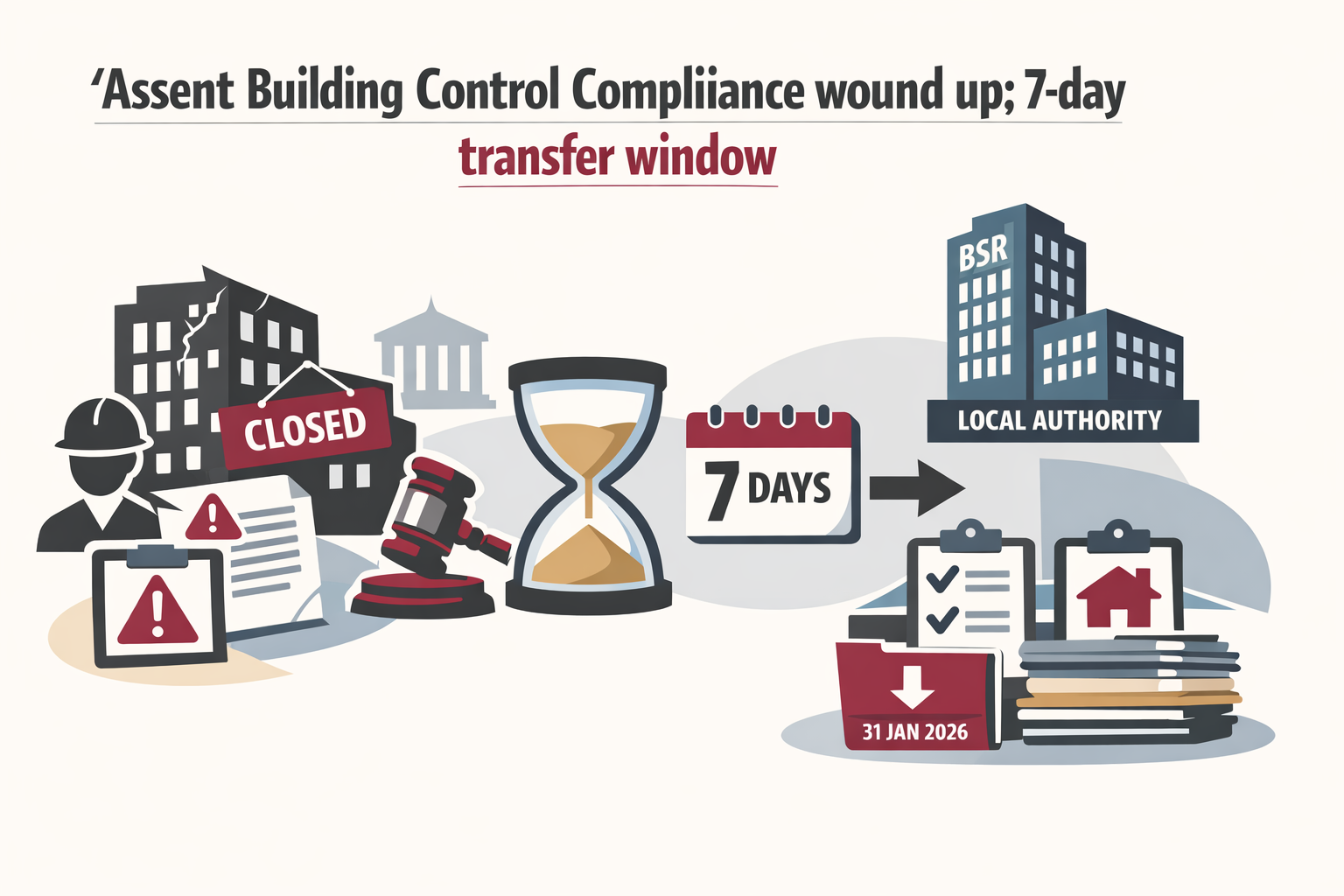
Winding‑up orders on 6 November 2025 shut down Assent Building Control Compliance Ltd alongside its registered building control approvers LB Building Control Ltd and Oculus Building Consultancy Ltd, with the court appointing the Official Receiver as liquidator. The Health and Safety Executive (via the Building Safety Regulator) issued an operational notice the next day setting out what project owners must do now.
Government material refers to the lead company by two names: “Assent Building Compliance Limited” in the Insolvency Service notice and “Assent Building Control Compliance Limited” in HSE’s operational notice. Both point to company number 05311596; creditors should rely on the number when matching contracts, payments and correspondence.
LB and Oculus have issued cancellation notices for all live projects pursuant to their duty under section 52(1)(a) of the Building Act 1984. For non‑higher‑risk schemes, work can continue, but clients have seven days from the cancellation notice to appoint a new registered building control approver and have a fresh initial notice submitted; if not, the job automatically reverts to the local authority.
Every higher‑risk building project moves to the Building Safety Regulator. Work must stop until BSR confirms a valid application. HSE directs applicants to use its online service and to label submissions “formerly Assent/LB/Oculus” so the case can be identified quickly.
Assent customers have been told to download project records using a portal link that expires on 31 January 2026. Officials warn there is no guarantee of access after that date. Anyone relying on these files to evidence compliance should secure them immediately.
Expect scrutiny of the build record. A new RBCA must decide whether unfinished work complies and then provide transfer certificates and a transfer report. If it cannot make that determination, the local authority must cancel the new initial notice. Where records are incomplete, councils can require opening‑up works to check compliance - adding cost and delay.
Costs are likely to rise where projects revert. Councils set their own reversion fees; as one published example, Barnet Council charges 150% of the building notice rate for a reversion application. Schedules vary by authority, but no client should assume a free transfer.
Those who prepaid for plan checks or inspections that will not be delivered are unsecured creditors and should file a proof of debt with the Official Receiver. The Insolvency Service has provided a dedicated mailbox and guidance; employees can apply for statutory redundancy and related payments through the Redundancy Payments Service.
For higher‑risk schemes, any part‑final certificates already issued remain valid and should be flagged to BSR with the new application. For non‑HRB projects that revert to a council, existing part‑finals from LB or Oculus can be submitted to assist the authority’s assessment.
Local authorities cannot refuse a reverted non‑HRB project. HSE’s practice guidance acknowledges capacity pressures and points councils to central government and LABC for support; clients should not accept capacity‑based deflection when attempting to hand a reversion over.
Accountability now sits with the Official Receiver, who says she will wind down the companies and investigate the cause of failure and the conduct of current and former directors. Creditors should monitor the liquidator’s reports closely, including how client data is preserved and how any prepaid fees are treated.
Two dates matter. The seven‑day transfer window runs from the date on each cancellation notice; for notices dated 6 November 2025 the deadline falls on 13 November 2025. Assent’s document link is due to expire on 31 January 2026. Missing either point will escalate risk and cost on site.