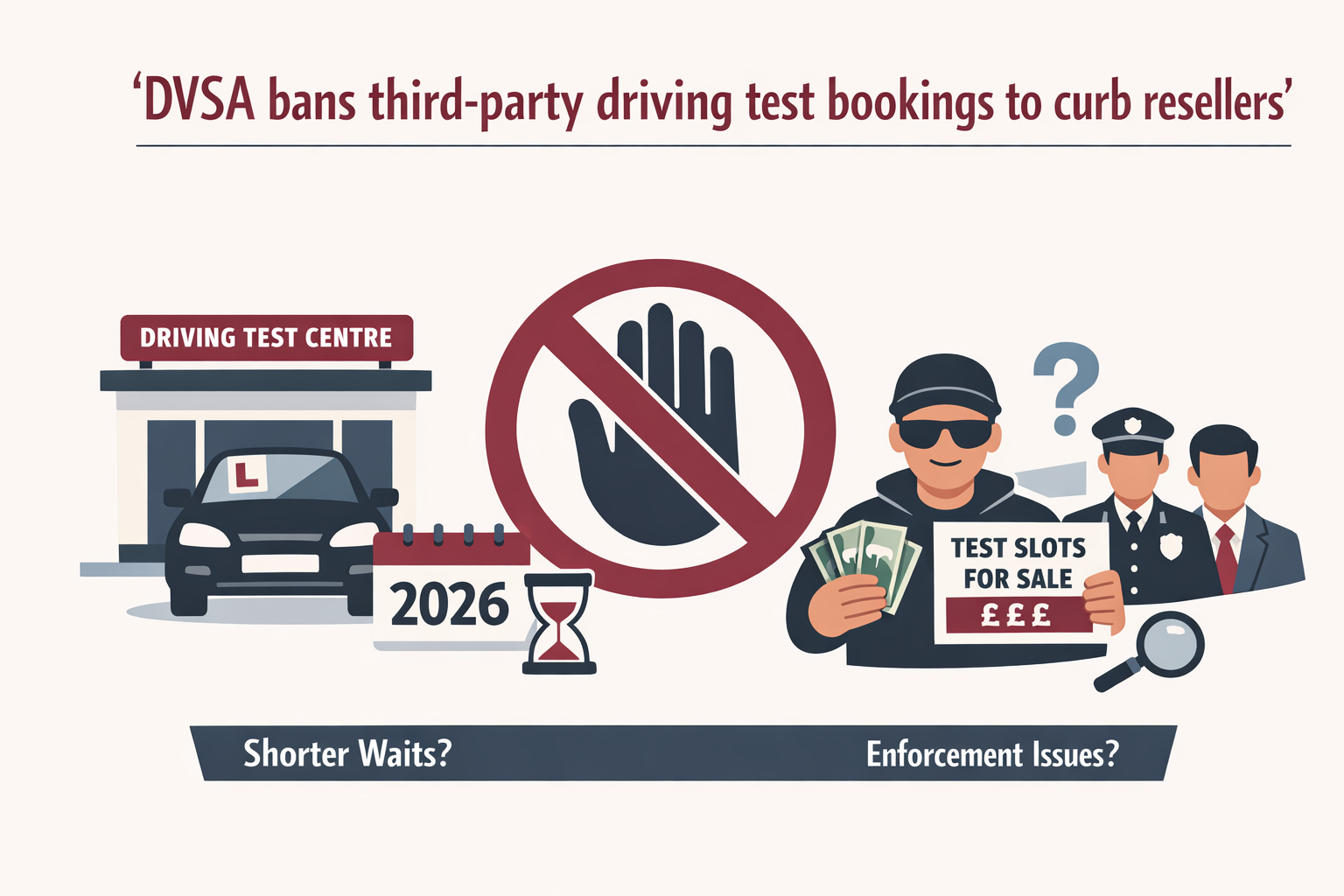
In its GOV.UK announcement, the Driver and Vehicle Standards Agency says car driving test bookings must now be made by the learner, not by a third party acting in their name. That change reaches beyond the cancellation-finder services that have built businesses around scarce slots. It also catches driving instructors and others who previously handled bookings for pupils. The legal line is sharper than the old arrangement. DVSA says it is now unlawful for third parties to make a booking for someone else, and a breach of the agency's booking terms for someone else to change, swap or cancel a test. After years in which access to a public service could be packaged up and resold, ministers are finally trying to shut the door.
Ministers are presenting the move as a fairness measure. Roads minister Simon Lightwood says the government inherited record waiting times and a swollen backlog, and he points to almost 2 million tests delivered over the past year, more than 158,000 extra tests since June 2025 and the use of military driving examiners to add capacity. That official case is convenient, but it also amounts to an admission. A resale market does not appear in a healthy system. It appears when official supply is too tight, oversight is too weak and learners become desperate enough to pay above the standard fee simply to get on the road.
Beverley Warmington, DVSA's chief executive, says the agency wants to stop learners being exploited by businesses that use bots and bulk tactics to secure appointments and then sell them back at inflated prices. The point is hard to dispute. Once a scarce public appointment becomes a tradable asset, those with the least money are pushed further back in the queue. What the press release does not explain in any detail is how the crackdown will be policed. The announcement sets out the prohibition, but says far less about detection, sanctions and enforcement data. If unofficial services have been gaming the system at scale, learners and instructors will want more than a promise that the rules have changed.
The numbers quoted by DVSA matter because they set a benchmark for what learners should actually be paying. The official fee remains £62 for a weekday car test and £75 for evenings, weekends and bank holidays. Any demand for more than that to secure a slot is precisely the kind of margin this policy is supposed to squeeze out. The new rules also build on restrictions already brought in on 31 March 2026, when the number of times a test can be changed was cut from six to two. From 9 June 2026, learners will only be able to move a test to one of the three nearest driving test centres. DVSA says that should deter speculative bookings in places where candidates never intended to sit the test. It may well do that, but it also leaves less room for learners who have legitimate reasons to look further afield because local capacity is poor.
Driving instructors and driving schools are not being written out altogether. DVSA says they can still advise pupils on readiness and set the times they are available, so learners do not book slots their instructor cannot cover. That preserves the teaching relationship, but it redraws the boundary around money and control. There is a practical tension here. When shortages bite, pupils often turn to instructors because they cannot make the system work on their own. The agency is now telling instructors to carry the expectations of anxious learners without touching the booking itself. Whether that reduces abuse or simply redirects frustration remains to be seen.
DVSA's wider defence is that capacity is improving. As of April 2026, it says there were 1,604 full-time equivalent driving examiners in post, the highest level since March 2018, and training capacity for new examiners has been doubled. Those are not trivial figures. They suggest the agency recognises that rule changes alone will not cut waiting times if there are not enough examiners to run the tests. The provisional statistics also show a recovery in volume. According to the government's own data table DRT121G, 1,998,608 car driving tests were taken between April 2025 and March 2026, up 8.6% on the previous year. Passes rose faster, with 1,000,043 successful tests over the same period, an increase of 11.7%. Yet the longer run is uneven rather than cleanly upward, with total tests dipping in 2024 to 2025 before rebounding. That matters because a backlog is not cleared by one better year if demand continues to outstrip local supply.
For learners, the immediate message is simple enough: book through the official channel, pay the official fee and be wary of anyone selling quicker access. For ministers, the message is less comfortable. Closing the door on middlemen is the easy part to announce; proving that the market cannot reopen under a different name is harder. This is why the next test for DVSA is not rhetorical but operational. If the agency wants confidence, it will need to show shorter waits at the centres under the most pressure, publish how it is enforcing the new rules and make clear whether suspect bookings are being cancelled before they are flipped for profit. Until that evidence appears, the crackdown looks necessary, but not yet complete.