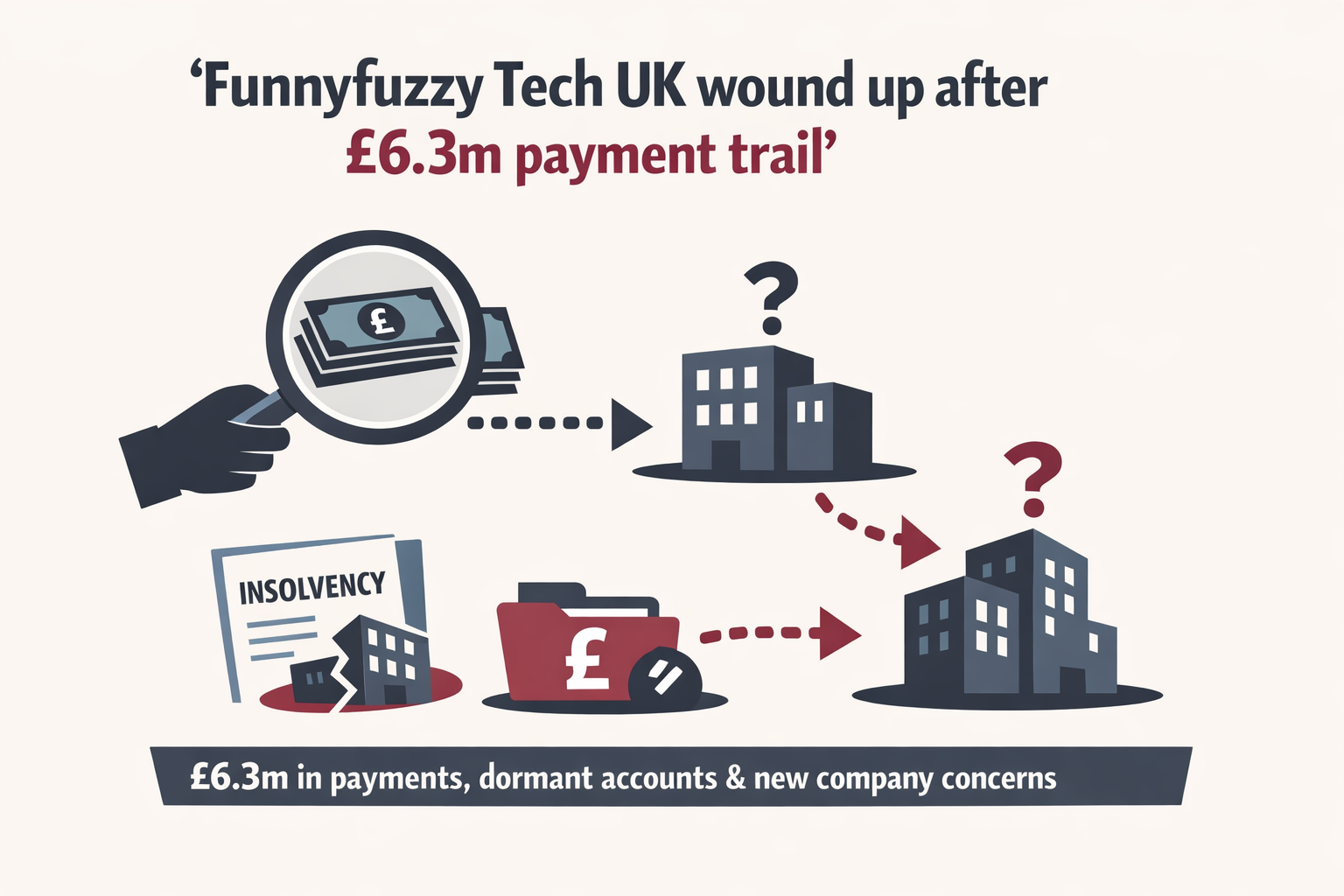
Funnyfuzzy Tech UK Co., Ltd has now been forced out of the market, with the High Court making a winding-up order on 22 September 2026 after an Insolvency Service investigation. The petition was presented in the public interest under section 124A of the Insolvency Act 1986, a power the Secretary of State can use where it appears expedient in the public interest for a company to be wound up. (gov.uk) That matters because this was not framed as a one-off consumer dispute. The Insolvency Service says the company traded through funnyfuzzy.co.uk, sold pet products to UK consumers and attracted complaints about non-delivery, delays, poor quality goods, failed refunds and poor customer service. (gov.uk)
The most striking discrepancy sits on the public file. Companies House shows Funnyfuzzy Tech UK filed dormant accounts for the years ended 31 July 2024 and 31 July 2025, yet the Insolvency Service says investigators identified more than £6.3 million in incoming payments between August 2023 and January 2026. (find-and-update.company-information.service.gov.uk) That gap is hard to dismiss. It raises the obvious question of how a company could present itself as dormant on the public record while still taking substantial sums online, particularly when Companies House also records a DS01 application to strike the company off on 11 May 2026, with the voluntary strike-off later suspended on 2 June 2026. (find-and-update.company-information.service.gov.uk)
On paper, Companies House listed Shuo Chen as both director and secretary from incorporation on 25 July 2023, using 41 Devonshire Street, London as the correspondence address and giving China as the place of residence. The Insolvency Service says investigators found no evidence of the company at that Devonshire Street registered office. (find-and-update.company-information.service.gov.uk) The company’s answer to investigators, according to the official account, was that it operated outside the UK. That did not prevent it from selling to UK residents, and the Insolvency Service says it used a UK contractor to handle customer returns while still refusing to provide books and records. (gov.uk)
For customers, the practical effect was blunt enough: money paid out, goods delayed or not received, and refunds that did not arrive. Complaints were made not only to the Insolvency Service but also to Action Fraud and Trading Standards, which gives a clear sense of how widely concern had spread. (gov.uk) When a consumer-facing company keeps trading while the identity behind the website shifts, the first casualty is basic accountability. Buyers are left trying to work out who took the order, where the seller is based and who, if anyone, will honour a refund. The Insolvency Service says the company information shown on the website changed repeatedly, including company names and addresses. (gov.uk)
The repeated use of new corporate wrappers is what makes this case more than a routine online retail failure. The Insolvency Service had already shut down Funnyfuzzy UK Co., Ltd in 2024 after finding it had traded in the same way through the same website. Companies House records show that predecessor company, number 13336978, entered compulsory liquidation after a petition dated 11 September 2024 and a winding-up commencement date of 19 November 2024. (gov.uk) Even after that, the website did not simply disappear from view. The Insolvency Service says Funnyfuzzy Tech UK then traded through funnyfuzzy.co.uk, and that the latest version of the site was linked to a Hong Kong-registered company, Funnyfuzzy HK Tech Limited. The agency has also acknowledged that transfers of website ownership can frustrate closure efforts, which helps explain why consumers can face the same complaints under a slightly altered corporate badge. (gov.uk)
The legal route is worth noting because it tells readers how seriously the state viewed the conduct under review. Section 124A allows the Secretary of State to petition where it appears expedient in the public interest and the court thinks it just and equitable to wind the company up. That is not the usual pattern of an unpaid supplier chasing a debt; it is a public-interest intervention. (legislation.gov.uk) Mark George, the Insolvency Service’s Chief Investigator, said the department was trying to stop those behind objectionable trading from simply reappearing through a different entity. That is the pressure point in this case. One company can be removed from the register or put into liquidation, but if the payment routes, website control and trading identity move elsewhere, the underlying problem can survive the court order. (gov.uk)
The file now passes to the Official Receiver’s Public Interest Unit, which the Insolvency Service has named as the contact point for enquiries into Funnyfuzzy’s affairs under reference LQD08007147. For affected customers, that is the next formal channel, but the public statement offers no assurance on refunds or recoveries. (gov.uk) What this case exposes, again, is how easily a website-facing retailer can blur the line between dormant company filings, cross-border trading and disappearing accountability. The High Court order removes one UK entity. Whether that also ends the trading model is the question creditors, customers and regulators will still be asking. (gov.uk)