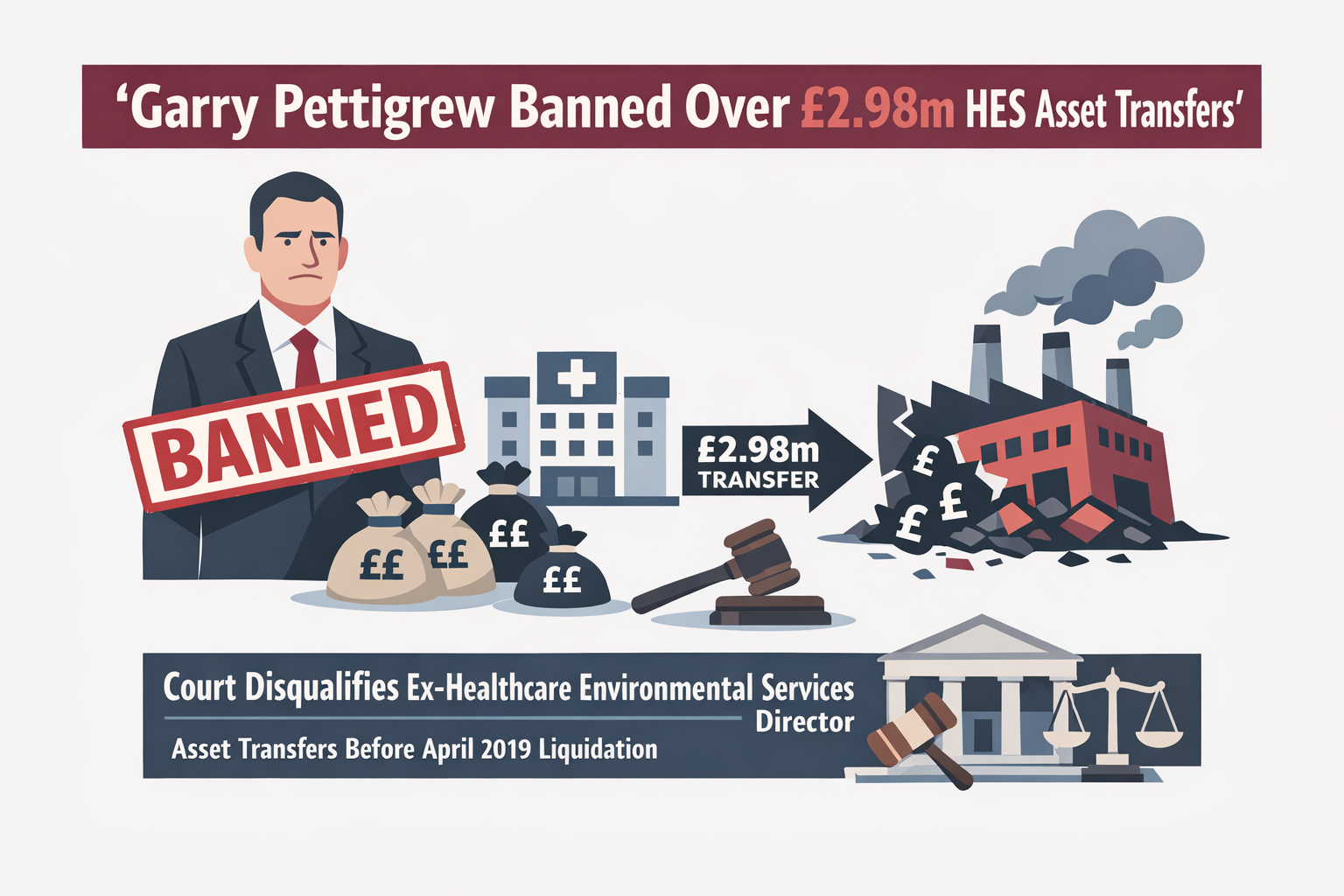
Seven years after Healthcare Environmental Services Limited fell into compulsory liquidation, the Court of Session has disqualified former director Garry Pettigrew for nine years after finding that almost £3 million of company assets were moved to connected companies as NHS contracts collapsed. The Insolvency Service says the transfers totalled £2,979,383; Companies House records show HES entered compulsory liquidation on 25 April 2019 with James Bernard Stephen appointed, while the government says debts exceeded £15 million. (govdiff.njk.onl) For creditors, that timeline matters. A disqualification order can stop a director running companies without the court’s permission, but it does not by itself replenish an estate that has already been stripped of saleable assets. (gov.uk)
The sequence described by the Insolvency Service is stark. In September 2018, Pettigrew met NHS and government officials over allegations that waste was being stockpiled in breach of Environment Agency permits. In early October 2018, HES lost 17 NHS England contracts across two days. Between October and December 2018, assets were then transferred out to HEG Sustainable Solutions Limited and Starryshaw Consultants Ltd, companies then directed only by Pettigrew and his wife. (govdiff.njk.onl) That is the point at which this ceased to be a trading downturn and became a creditor protection issue. Once valuable contracts were falling away and insolvency risk was plain, moving equipment to connected parties called for proper process, independent scrutiny and secured-lender consent, not family-circle decision-making. (govdiff.njk.onl)
The government release says those transfers were made without the consent of the company’s bank, even though HES had been told by its accountants and solicitors that consent was required. Companies House records show multiple charges over HES assets, including outstanding HSBC charges and a floating charge delivered in September 2014. In plain English, this was not free property that could simply be shifted elsewhere because the director preferred it there. (govdiff.njk.onl) Connected-party deals are not automatically improper. But when assets leave just as trading collapses, and when the recipient companies sit under the same household’s control, the burden is on the director to show the transaction was properly authorised, properly valued and fair to the creditor body as a whole. On the official account, that case was not made here. (govdiff.njk.onl)
By December 2018, an attempted sale of HES had failed, trading had ceased and staff were made redundant. Four months later, on 25 April 2019, the company was in compulsory liquidation. That gap is important: by the time the formal insolvency process began, the assets now criticised by the court had already been moved beyond the immediate reach of the insolvent estate. (govdiff.njk.onl) Inside Corporate Insolvency readers will notice what the press release does not say. It says the conduct has been punished. It does not say whether the £2.979 million was recovered, whether claims were pursued against the recipient companies, or what dividend, if any, unsecured creditors can realistically expect from an estate said to owe more than £15 million. (govdiff.njk.onl)
On 20 August 2026, Lord Lake disqualified Pettigrew for nine years, with the government announcing the outcome the following day. The judge described Pettigrew’s conduct as a 'flagrant' breach of director duty and placed the case at the top end of the middle bracket for disqualification. That matters because the court was not dealing with a paperwork lapse. It was dealing with conduct said to have prejudiced creditors at the point of corporate failure. (govdiff.njk.onl) The proceedings were also unusually combative. Pettigrew was fined £1,000 and expenses in June 2025 after a contempt finding over photographing witnesses and reposting offensive social-media comments about them. Earlier Scottish court papers show the witness group included representatives from NHS England, HSBC UK Bank plc and the Insolvency Service. (govdiff.njk.onl)
This was not a one-person board. On 6 August 2021, Alison Pettigrew, his co-director, gave a 3.5-year disqualification undertaking for allowing the transfers to happen. That earlier outcome has always raised an awkward question about governance at HES: if both directors were involved, who, if anyone, was protecting the company from decisions that plainly advantaged connected entities at the worst possible moment? (govdiff.njk.onl) The connected companies named in the transfers did not disappear from the record. Companies House currently shows HEG Sustainable Solutions Limited as dissolved on 9 January 2024, while Starryshaw Consultants Ltd remains active. For any creditor still reading the fine print of this collapse, those statuses are not background colour; they go to the practical question of where value went and whether it can still be chased. (find-and-update.company-information.service.gov.uk)
There is also a point worth stating clearly. Separate criminal proceedings over alleged illegal storage of medical waste were dropped in October 2023. That did not prevent the civil disqualification case from succeeding. The two tracks ask different questions: one about criminal liability, the other about fitness to act as a director and conduct harmful to creditors. (govdiff.njk.onl) That distinction is often lost once a collapse attracts public attention. It should not be lost here. The Pettigrew ruling is, above all, a case about asset movements, connected-party control and the duties owed when insolvency is no longer a remote risk but a present reality. (govdiff.njk.onl)
The Insolvency Service says it hopes the ban will warn other directors against putting themselves first when insolvency looms. That is the official message, and it is plainly justified on the court’s findings. But creditor protection is measured not only by bans imposed years later. It is measured by whether value is preserved before liquidation, whether connected-party transfers are unwound in time and whether those left with the bill see more than a press release. (govdiff.njk.onl) From April 2019 to August 2026 is a long time for unsecured creditors to wait in a case involving NHS contracts, regulated waste services and almost £3 million of disputed asset movements. The ban until 2035 is significant. Whether it is enough will depend on what the liquidation file says about recovery, not simply on what the headlines say about punishment. (govdiff.njk.onl)