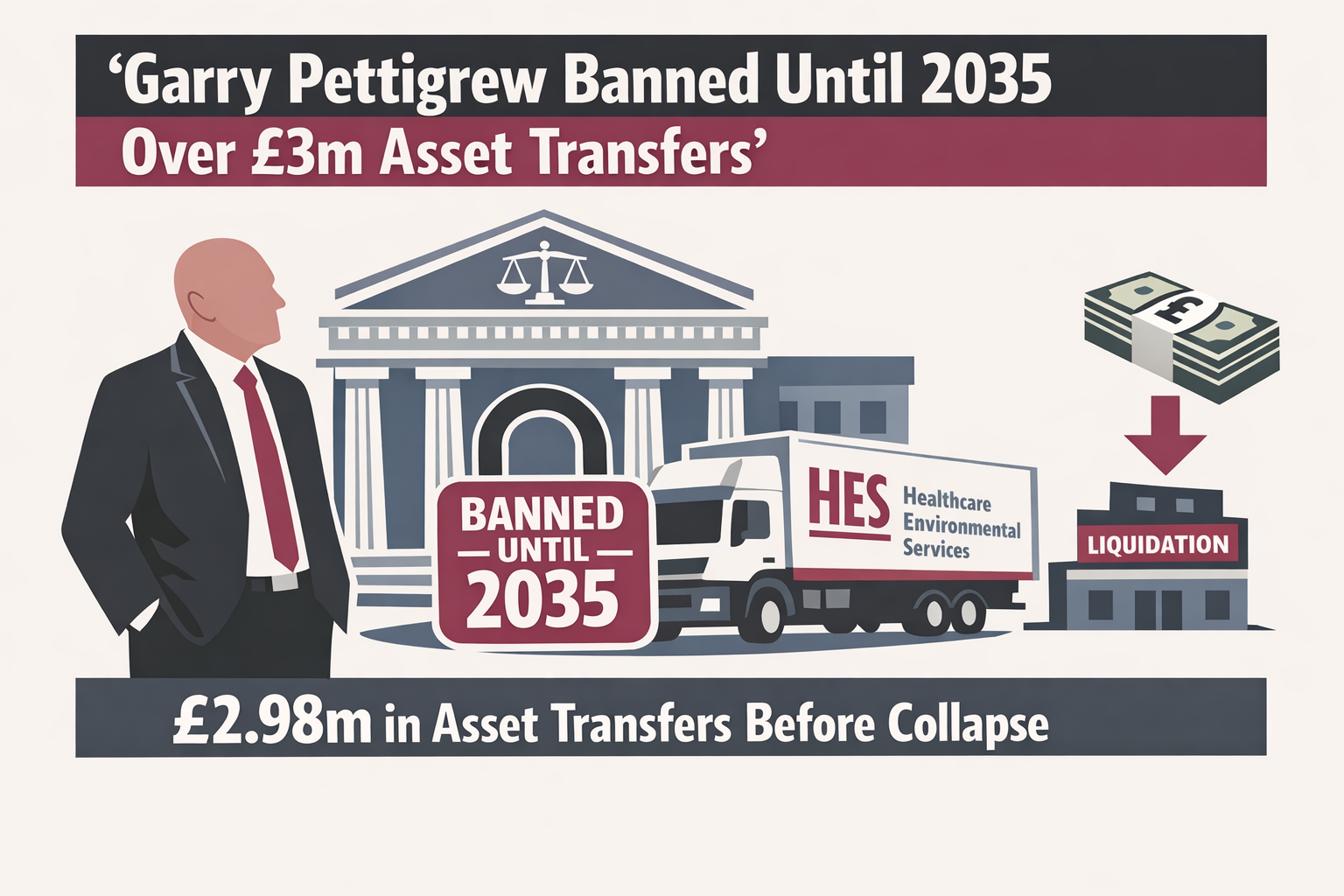
Lord Lake’s ruling in the Court of Session on Thursday 20 August 2026 has put Garry Pettigrew out of the boardroom for nine years, a ban that runs until 2035 unless he obtains court permission. The former director of Healthcare Environmental Services Limited, the waste contractor once used by NHS bodies, was found to have moved almost £3 million of company assets to connected companies as the business was losing the contracts that kept it alive. For creditors, that sequence matters more than the headline punishment. Healthcare Environmental Services entered liquidation in April 2019 owing more than £15 million. By then, assets worth £2,979,383 had already been shifted away from the company. In plain terms, property that might have supported recoveries was no longer sitting where creditors, staff and the secured lender would have expected to find it.
According to the Insolvency Service, Pettigrew began moving equipment out of the company just days before 17 NHS England contracts were terminated across two days in early October 2018. Those cancellations followed a September 2018 meeting with NHS and government officials to discuss allegations that waste had been stockpiled in breach of Environment Agency permits. Further NHS contracts were then terminated in December 2018. That timing strips away any suggestion that this was routine housekeeping inside a healthy group. A director who knows a business is losing its income base is not free to treat company assets as family property. Once insolvency is on the horizon, the legal focus turns to creditors’ interests. The court’s finding went to that simple question: what was being protected as the company failed, and who was being left exposed.
Between October and December 2018, the assets moved from Healthcare Environmental Services Limited to HEG Sustainable Solutions Limited and Starryshaw Consultants Ltd. At the time, Garry Pettigrew and his wife were the only directors of those recipient companies. Connected-party transfers of this sort nearly always demand close inspection in an insolvency because control sits on both sides of the transaction while outside creditors have no seat at the table. The position became worse because the company’s bank held a charge over all the firm’s assets. The Insolvency Service said the transfers went ahead without the bank’s consent, despite advice from the company’s accountants and solicitors that consent was required. That is not a minor paperwork failing. If a secured lender holds a charge, moving the charged assets without approval can prejudice the lender and shrink what is left for everyone else.
Companies do sometimes move assets within a group for legitimate reasons, but that usually requires proper value, proper records and respect for existing security. The Court of Session was dealing with something quite different: assets leaving a distressed company for businesses controlled by the same household while the trading position was plainly deteriorating. Lord Lake described Pettigrew’s conduct as a 'flagrant' breach of his duties and placed the case at the top end of the middle bracket for disqualification, leading to a nine-year ban. Courts do not use that language for a mere misjudgement. It points to a finding that the director knew, or should obviously have known, that the company’s creditors were being put in a worse position.
Any hope of a rescue had fallen away by December 2018, when an attempted sale of the company collapsed and trading ceased. All staff were made redundant. By April 2019, Healthcare Environmental Services was in liquidation with debts of more than £15 million. For employees and trade creditors, this is where the human cost sits. An unpaid supplier may get only pence in the pound, if anything at all, after secured claims, office-holder costs and litigation expenses are dealt with. Former staff face redundancy processes and capped claims. When assets have already been moved to connected companies before the liquidation starts, the question for creditors is not academic; it goes directly to whether there is a meaningful estate left to pursue.
The Insolvency Service began investigating shortly after the April 2019 liquidation. Alison Pettigrew, who served as co-director, gave a director disqualification undertaking on 6 August 2021 for three and a half years after allowing the transfers to take place. Garry Pettigrew contested the case, with the final court ruling arriving on 20 August 2026. That is more than seven years after the company failed, a timescale that creditors may find hard to welcome even where proceedings are defended. The court record also picked up conduct outside the asset-transfer issue. In June 2025, Pettigrew was fined £1,000 and ordered to pay costs after being found in contempt of court for photographing witnesses in breach of a court prohibition and then republishing the images with offensive comments on social media. That episode did not create the original insolvency misconduct, but it did little to support any claim of careful or responsible conduct during the proceedings.
There was a separate criminal track. Proceedings brought by the Crown Office and Procurator Fiscal Service over allegations of illegally storing medical waste were dropped in October 2023. That result should be kept in its proper place. The director ban did not depend on those abandoned criminal allegations; it depended on the court’s findings about what happened to company assets as Healthcare Environmental Services unravelled. The ban now prevents Pettigrew from promoting, forming or managing a company without the court’s permission until 2035. The broader point is a familiar one in insolvency work: by the time enforcement catches up, the business has gone, the jobs have gone and the creditor damage is already done. Disqualification marks misconduct, but it does not refill an emptied estate. That is why connected-party transfers, ignored professional advice and pre-liquidation asset movements deserve scrutiny early, not just after the regulator arrives with a press release.