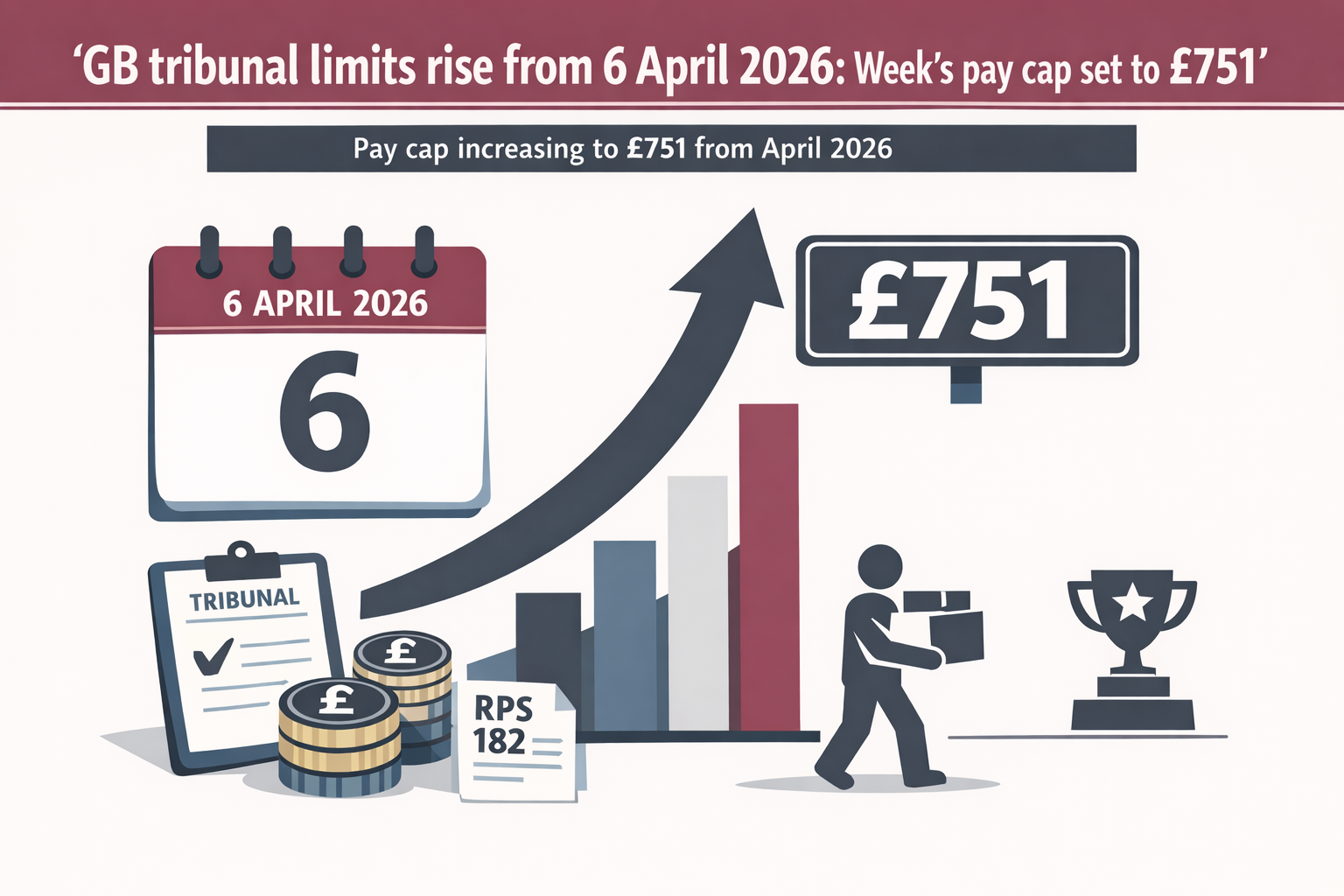
The government has signed off its annual uprating of employment tribunal and statutory payment limits for Great Britain, to take effect from Monday 6 April 2026. The Order applies the statutory indexation formula in section 34 of the Employment Relations Act 1999, using the Retail Prices Index for September 2025, which the Office for National Statistics confirmed at 4.5 percent. (ons.gov.uk)
For insolvency cases, the number that matters most is the week’s pay limit used for statutory redundancy and basic awards under the Employment Rights Act 1996 and for Redundancy Payments Service (RPS) calculations. Based on the published 2025 baseline of £719 per week and the Order’s 4.5 percent indexation, Inside Corporate Insolvency calculates the GB cap will move to £751 per week from 6 April 2026. We derive this by applying the RPI uplift to the 2025 figure set out by leading practitioners. (dwfgroup.com)
What does that mean in cash terms for insolvency estates and the National Insurance Fund? RPS liabilities that are capped by “a week’s pay” will step up proportionally. The maximum arrears of pay payable by RPS rises to 8 weeks at £751 (£6,008), statutory holiday pay to 6 weeks at £751 (£4,506), statutory notice pay to 12 weeks at £751 (£9,012) before benefit offsets, and any protective award paid by RPS remains capped at 8 weeks at the weekly limit. The Insolvency Service’s own guidance confirms the 8‑week cap on protective awards in insolvencies. (gov.uk)
For redundancy and basic awards in unfair dismissal, the new cap pushes up the theoretical maximum. Using the statutory formula (maximum 20 years’ service at 1.5 weeks per year), the ceiling for both the basic award and statutory redundancy increases to 30 weeks at £751, i.e. £22,530. This is a mechanical consequence of the uprating and will apply where the ‘appropriate date’-such as the relevant date for redundancy or the effective date of termination for unfair dismissal-falls on or after 6 April 2026. This mirrors the established approach seen in the 2025 Order and earlier rounds. (legislation.gov.uk)
Transitional timing now becomes a live issue in administrations that straddle the change. The Order preserves the previous limits for events before Sunday 5 April 2026, but switches to the new figures from Monday 6 April 2026. In practice: an unfair dismissal claim keyed to the effective date of termination on 5 April uses the old cap; on 6 April it uses the new cap. Likewise, RPS ‘appropriate date’ tests under section 185 ERA govern whether the old or new weekly limit applies. IPs who are setting cut‑off dates or issuing termination notices around Easter week should record the trigger dates with precision to avoid misapplication and disputes. (legislation.gov.uk)
There are also day‑to‑day payroll knock‑ons. The daily rate for statutory guarantee pay-£39 in 2025-will track the same 4.5 percent uprating, taking it to £41 per day on our calculation, subject to the Order’s rounding rules. While modest in isolation, guarantee pay often surfaces in large‑scale insolvency shutdowns where shifts are cancelled at short notice and staff are stood down. Practitioners should expect the RPS to police this closely against eligibility and days‑worked rules. (womblebonddickinson.com)
Protective award exposure is rising on two fronts. First, the weekly cap that RPS will pay in insolvent cases increases as above. Second, separate government plans-trailed by firms tracking the Employment Rights Act 2025 rollout-point to the maximum protective award moving from 90 to 180 days’ pay in Great Britain during 2026. That second change is outside this uprating Order, affects solvent and insolvent employers alike, and will not lift the 8‑week RPS payment cap, but it will raise gross awards that sit as unsecured claims in estates. Track commencement to avoid under‑reserving. (lewissilkin.com)
RPS processing rules also matter. The Insolvency Service’s Dear IP guidance confirms that, when calculating capped weeks in insolvency, RPS pays the “best weeks” up to the permitted maxima (for example, up to eight weeks including any protective award), and expects IPs to supply robust pay data-now typically a 52‑week reference for variable holiday pay. With a higher weekly cap in play, poor data quality will cost creditors real money. (content.govdelivery.com)
Northern Ireland is on a separate track. The GB uprating Order extends to England, Wales and Scotland only. In Northern Ireland, a distinct Employment Rights (Increase of Limits) Order is considered by the Department for the Economy and the Assembly committee-employers with NI headcount should use NI‑specific limits and commencement dates once finalised. (consult.nia-yourassembly.org.uk)
Finally, a reminder on unfair dismissal compensatory awards. For events between 6 April 2025 and 31 December 2026, the cap remains the lower of the statutory monetary maximum and 52 weeks’ pay; law firm trackers place the 2025 maximum at £118,223, which also uprates by 4.5 percent until the cap is abolished on 1 January 2027. From that date there will be no statutory ceiling, a change the government has confirmed in its implementation notes-another reason to lock down consultation and process in any pre‑pack or trading administration before year‑end. (dwfgroup.com)
What creditors should expect from their IPs this week is simple: updated redundancy and RPS exposure schedules priced on the new £751 weekly limit, transparent rationale for any timing decisions taken around the 5/6 April cliff‑edge, and clean RP14/14A data to avoid RPS queries later. The Order is formulaic, but the cost is real; slippage here transfers value from creditors to error. Inside Corporate Insolvency will keep score on cases that get this wrong. (dwfgroup.com)