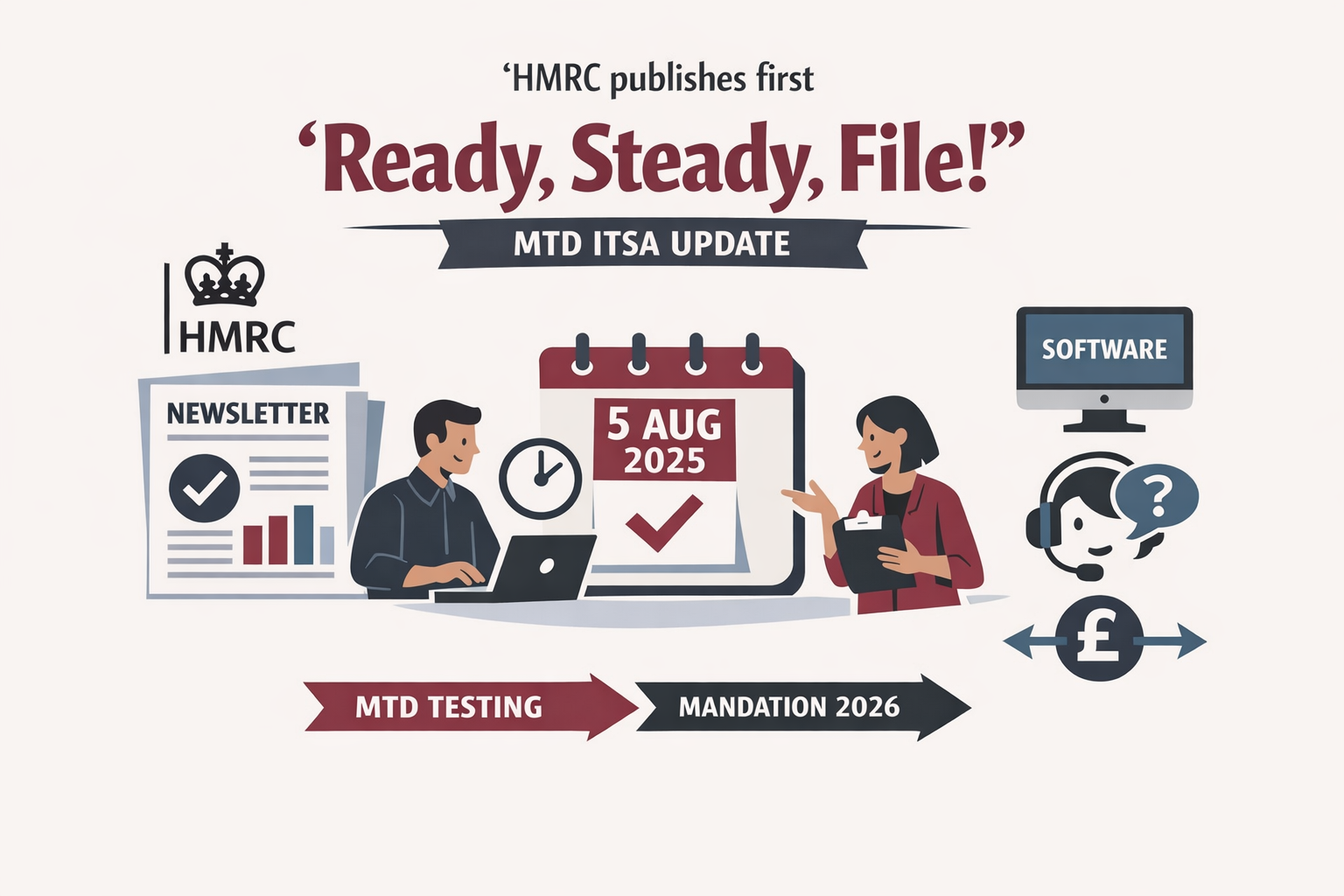
HMRC has published the first edition of Ready, Steady, File! on 7 November 2025, a newsletter aimed at volunteers in its Making Tax Digital for Income Tax (MTD ITSA) testing programme. The publication is framed as preparation for a major change to Income Tax reporting and invites testers to help shape the service before wider rollout.
The newsletter bills itself as a quarterly companion with updates, tips, research insights and routes for feedback. It is presented as part of HMRC’s 2025 testing programme and is intended to keep participants aligned with milestones during the ramp‑up.
One section highlights an “Important date” for a first quarterly update due on 5 August 2025 and confirms there are no late‑submission penalties during the testing phase. That deadline sits in the past relative to the 7 November 2025 publication date, raising basic questions about how clearly HMRC is signposting live obligations to testers in a single, authoritative place.
HMRC says it has already proven key components: the sign‑up process for individuals and agents (including non‑standard accounting periods), the ability to make and amend quarterly submissions, adding income sources, opting out of quarterly obligations, PAYE income pre‑populating estimates for payments on account, and the correct allocation of payments to charges. If accurate at scale, these are the moving parts that will determine whether quarterly reporting works day‑to‑day.
Looking ahead, the department sets out further testing: pushing higher sign‑up volumes, enabling multiple agents so one can handle quarterly updates while another completes end‑of‑year work, and live validation of the first quarterly updates via software during July to September 2025. The acid test will be whether these features hold under pressure when the service opens to mandated users.
Support is flagged, including a dedicated phone line for MTD for Income Tax beta participants (0300 322 9619, Monday to Friday, 8am–6pm), plus ongoing user‑research opportunities. That level of hand‑holding may reassure early adopters, but it will need to scale rapidly as participant numbers rise.
On software, HMRC states it will not build free software of its own but says free options exist for small businesses with the simplest affairs, directing users to its software finder and stressing it does not endorse specific products. For cash‑tight traders, the practical availability and capability of any “free” tier will be critical to compliance without adding cost pressure.
Mandation begins on 6 April 2026 for sole traders and landlords with qualifying income over £50,000, extending to those with £30,000–£50,000 from April 2027. Under that regime the first statutory quarterly update deadline is 7 August 2026, so reliable software and disciplined record‑keeping need to be in place well before then.
Further changes set out in 2025 bring those with £20,000+ qualifying income (as measured in 2026–27) into scope from April 2028, alongside penalty reforms allowing HMRC to cancel or reset late‑submission points in certain circumstances. HMRC has also clarified deferrals and exemptions, including routes for those who are digitally excluded to apply not to use MTD for Income Tax.
For creditors and owners watching solvency risk, the takeaway is straightforward: quarterly digital reporting will change how micro‑businesses manage cash, bookkeeping and agent relationships long before any tax is payable. Early software trials, consistent data capture and a written plan for the April 2026 switch are now basic control checks; without them, avoidable penalties and poor information are likely to spill into already stressed ledgers.