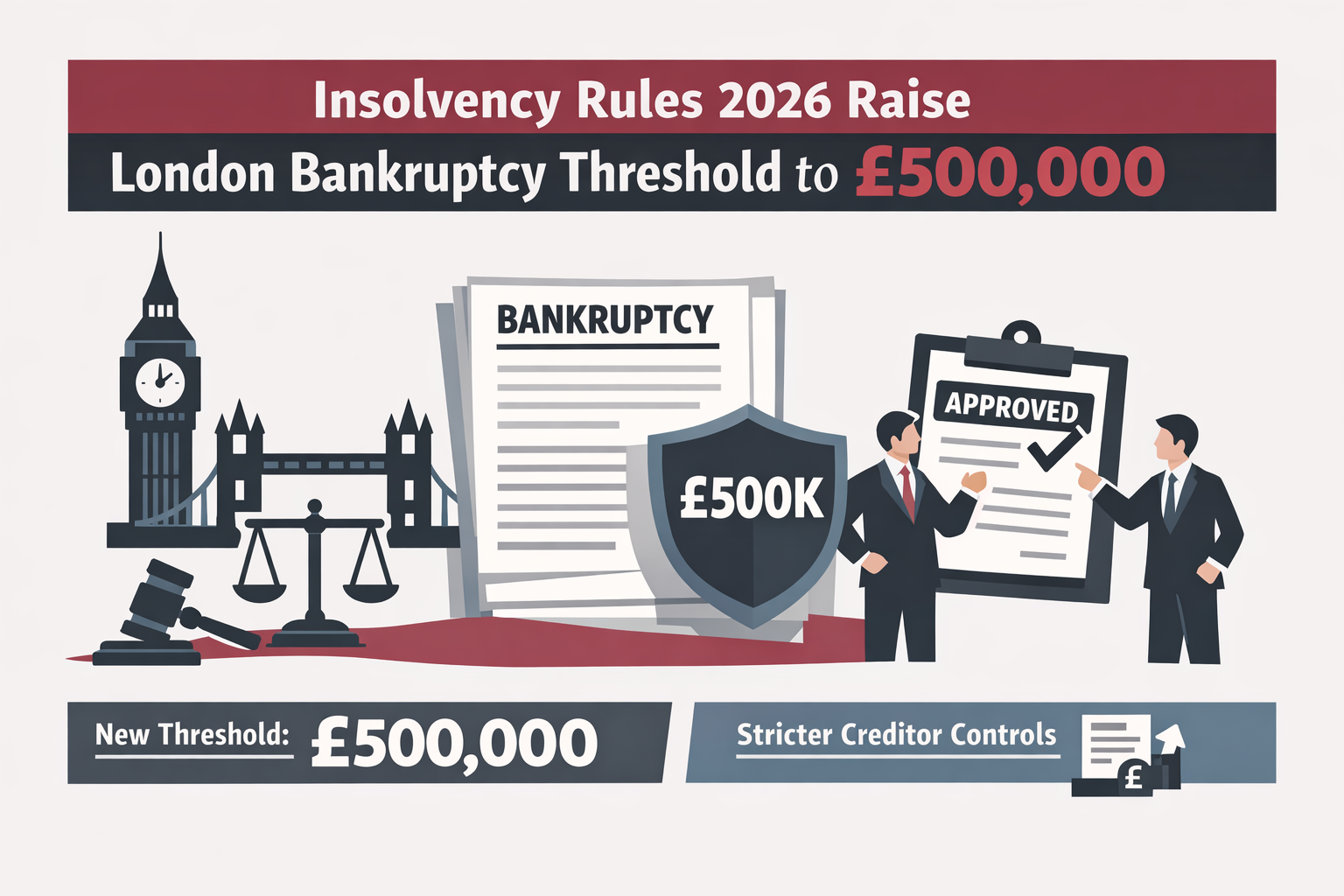
Whitehall is billing SI 2026/561 as a tidy-up of the Insolvency (England and Wales) Rules 2016 after a review of how those rules have operated. Formally, the instrument was laid before Parliament on 28 May 2026 under the made negative procedure, and it comes into force on 22 June 2026. That sounds routine. It is not entirely routine for creditors, debtors and office-holders who actually have to live with the consequences. (statutoryinstruments.parliament.uk) The government has packaged the changes as corrections, clarifications and modernisation. But buried in the drafting are three points that matter in practice: a tenfold jump in the London bankruptcy petition threshold, a cleaner route for policing fee overruns, and a long-overdue rewrite of rules that still assumed the fax machine was part of insolvency life. (judiciary.uk)
Under the 2016 rules, an out-of-hours administration appointment could still be filed by fax or email, with the appointer keeping either a fax transmission report or a hard copy of the email. SI 2026/561 strips fax out of that machinery and recasts the evidential focus around email timing. For a court system that no longer accepts fax filing, that is sensible. It is also an admission that the rulebook had fallen behind ordinary practice. (legislation.gov.uk) That matters because out-of-hours appointments are used when a company is running out of road and every hour counts. When an appointment is challenged, arguments about exactly when notice was filed can affect validity, trading authority and everything that follows. A procedural clean-up is welcome, but it should not have taken a decade-long lag between practice and black-letter rules to get here. (legislation.gov.uk)
Elsewhere, the instrument removes the obsolete term "registrar" and rewrites a run of provisions so that court functions sit with a "judge" in accordance with the relevant practice direction. On one reading, that is mere drafting maintenance. On another, it narrows the room for parties to pick over whether the wrong judicial office-holder handled a transfer, block transfer application or related procedural step. For creditors, these are the sorts of points that only look dry until an office-holder, debtor or respondent decides to fight every inch of the case. Insolvency procedure has a habit of turning technical wording into expensive satellite disputes. Cutting away obsolete language is not glamorous, but neither is paying lawyers to argue over it.
The most important amendment is not about fax at all. Rule 10.11 is changed so that the financial limit for presenting bankruptcy petitions in the London Insolvency District rises from £50,000 to £500,000. That is a tenfold increase. It changes forum, cost and pressure points for a large band of London cases overnight. (judiciary.uk) The figure also closes a mismatch already visible in court guidance. The current Pilot Practice Note says petitions in the London Insolvency District are presented in the High Court where the debt is £50,000 or more, yet it also lists bankruptcy petitions with debts of £500,000 or less among the matters to be transferred to the County Court at Central London. SI 2026/561 appears to bring the filing rule closer to the transfer practice. For creditors owed between £50,000 and £500,000, that is not a cosmetic amendment; it is a routing decision with real cost consequences. (judiciary.uk)
The other amendment creditors should read closely sits in rule 18.30(2), on applications to exceed an office-holder's fee estimate. Since the fees reforms, remuneration was not supposed to move past the estimate without approval, and the route for approval depended on who fixed the basis in the first place. The 2026 rule now states the hierarchy more plainly: court if the court fixed the basis, committee if there is one and the court did not, and otherwise the creditors or class of creditors that fixed it. (legislation.gov.uk) That clarification matters because fee creep rarely lands on the insolvency practitioner; it lands on the estate. Every extra pound in remuneration is a pound that does not reach creditors. If a committee fixed the estimate, it is hard to justify an office-holder stepping around that committee when the budget no longer holds. On that point, the amendment is less a reform than a reminder that creditor consent is supposed to mean something. (legislation.gov.uk)
Some amendments are genuine corrections rather than policy shifts. One fixes the completion notice route in bankruptcy so that, where the case began with a debtor's application to an adjudicator, the trustee's notice on completion goes to the official receiver rather than the court. Another updates the wording around COMI and establishment proceedings so rule 8.24 matches post-EU-exit terminology already used elsewhere in the 2016 rules. (gov.uk) These are not headline changes, but they are the sort that stop unnecessary disputes at the back end of a case. Wrong recipient, wrong label, wrong form of proceeding: each can generate delay, extra correspondence and avoidable cost. In a solvent matter that is irritating. In an insolvent one, it comes straight out of a pot that is already too small.
What is harder to accept is the stock line that no full impact assessment was needed because no significant impact is foreseen. A tenfold jurisdictional jump in London bankruptcy petitions and a tighter statement of who must authorise fee overruns will not alter every case, but they will alter some cases where the money at stake is already scarce. Creditors are entitled to ask why that was treated as administrative housekeeping rather than something worth measuring. The practical test will come after 22 June 2026. Creditors' committees should watch fee applications more carefully, petitioning creditors in London should re-check forum before issuing, and office-holders should stop assuming the court will indulge procedural habits that survived only because everyone knew the rules were dated. SI 2026/561 is short. Its effects may not be. (statutoryinstruments.parliament.uk)