The Insolvency (England and Wales) (Amendment) Rules 2026 have been presented by government as a post-implementation clean-up of the 2016 Rules. The statutory instrument on legislation.gov.uk shows something more consequential than routine housekeeping. It was made on 27 May 2026, laid before Parliament on 28 May, and comes into force on 22 June 2026, with Sarah Sackman signing for the Ministry of Justice, Chancellor of the High Court Colin Birss concurring on procedural matters, and Blair McDougall concurring for the Department for Business and Trade. The official note says the changes follow a review of how the 2016 Rules have operated. That sounds modest. Yet the package reaches into court process, out-of-hours administration appointments, trustee exit on bankruptcy completion, creditor control over remuneration overruns, and the venue limit for bankruptcy petitions in the London Insolvency District. For creditors and advisers, that is not clerical tidying. It alters where cases go, how documents are proved, and who gets to sign off extra fees.
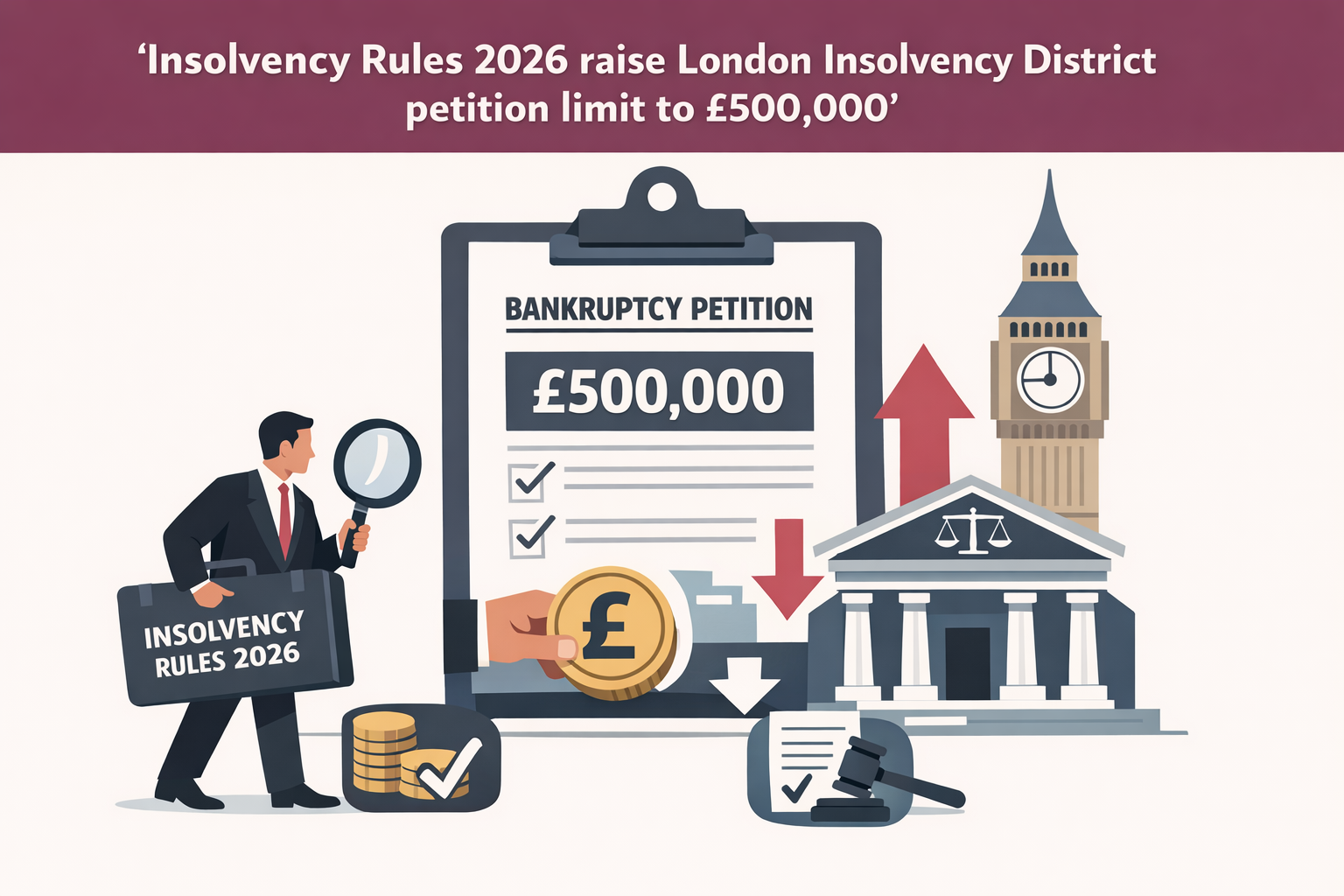
The change most likely to draw immediate attention is in rule 10.11. From 22 June 2026, the financial limit for presenting bankruptcy petitions in the London Insolvency District rises from £50,000 to £500,000. The Explanatory Memorandum says so directly, and the wording in the instrument amends rule 10.11(1)(a) and (b) by replacing £50,000 with £500,000. That point needs precision. This is a venue rule for presenting bankruptcy petitions in the London Insolvency District, not a wholesale rewrite of the statutory debt threshold for bankruptcy itself. Even so, a tenfold increase is serious. It is likely to move a large body of lower-value petition work away from London’s specialist forum and into other courts. Smaller creditors who have grown used to issuing in London will need to revisit precedent letters, filing routes and costs assumptions. The government has chosen not to produce a full impact assessment because no significant effect is foreseen. Given the scale of this venue change, that judgment looks open to challenge.
A second cluster of amendments removes the last remnants of fax-based procedure. Rules 4, 6, 7, 8, 12 and 14 strip out references to fax delivery to the courts and the Insolvency Service. Rule 1.45 now states in terms that electronic delivery does not include delivery by fax. Rule 1.46 is retitled and, more usefully, confirms that if a document is delivered electronically, only one copy is required even where the Rules would otherwise call for more than one. For practitioners dealing with urgent appointments, the practical effects matter. The out-of-court administration appointment provisions in rules 3.20 to 3.22 are rewritten so that proof of sending is tied to email rather than fax reports, including the date and time shown on the appointer’s hard copy of the email. That should remove outdated filing steps. But it also leaves firms with less room for error. If inboxes, servers or document retention systems are not properly managed, the old habit of relying on a fax transmission record is gone. In a disputed appointment, the evidence trail will have to be clean.
The instrument also removes the obsolete term registrar and substitutes judge across a range of provisions. Rule 3 changes the definition of judge so that it means an appropriate judge in accordance with any relevant Practice Direction, and it broadens the definition of Practice Direction to include insolvency-specific directions as well as CPR material. Rules 16 to 22 then make the consequential changes across transfer powers, block transfer applications, office copies and functions exercised on behalf of the official receiver. On one view, this is simply drafting that catches up with how the courts already work. On another, it shifts yet more practical meaning out of the black-letter rules and into practice directions that creditors and smaller businesses may not read until a problem has already arisen. The wording is cleaner, but users will now need to check the relevant practice direction more carefully before assuming which judge can deal with an application or transfer. For professionals that is manageable. For unrepresented petitioning creditors, it adds another layer between the text of the Rules and the real process.
Some of the amendments are plainly corrective, but corrections in insolvency procedure are rarely trivial when they touch the validity of notices. Rule 8.24 is updated so that the old reference to main, territorial or non-EU proceedings becomes a reference to COMI proceedings, establishment proceedings, or proceedings to which the EU Regulation as it has effect in the law of the United Kingdom does not apply. That brings the provision into line with rules 8.3 and 8.19 after the earlier EU Exit changes. COMI, for non-specialists, means centre of main interests, the concept used to determine where cross-border insolvency proceedings should be recognised as the main case. Rule 10.87 is more immediately operational. It corrects the route for a trustee’s notice on completion of bankruptcy. Where the bankruptcy began on a creditor’s petition, the trustee files notice with the court after giving notice to creditors under section 331. Where it began on a debtor’s application, the notice goes to the official receiver instead. That may sound technical, but it matters. A completion notice sent to the wrong destination can hold up the trustee’s exit from office and prolong an already expensive tail end of the case.
The amendment that deserves the closest reading from creditors is rule 18.30(2) on exceeding a fee estimate. The new wording makes the approval path explicit. If the court fixed the basis of remuneration, the office-holder must go back to the court. If there is a creditors’ committee and the court did not fix the basis, the request goes to the committee. In other cases where the creditors or a class of creditors fixed the basis, the request goes back to those creditors or that class. That clarification is more important than the government’s summary may suggest. Fee estimates are supposed to be a control, not a formality. In practice, creditors often complain that once an office-holder has secured appointment and started billing time, the pressure to approve more cost is strong and the information supplied can be thin. The revised rule narrows the room for argument about who must authorise an overrun. It points the decision back to the body that fixed the estimate, unless the court set the basis at the outset. For committees that want firmer cost discipline, that is a useful line in the sand.
Taken together, these amendments are best read as a package of procedural modernisation with a few sharp edges that should not be missed. The fax references are swept away, electronic filing is made slightly more sensible, and old terminology is brought into line with current court structures. But the instrument also redistributes work by raising the London Insolvency District petition limit, and it reinforces that creditors and committees are not spectators when office-holders want to break through agreed fee estimates. The Ministry of Justice says no significant impact is foreseen. Readers affected by insolvency proceedings may reach a different conclusion. By 22 June 2026, firms filing bankruptcy petitions will need to revisit venue assumptions, administrators using out-of-hours routes will need reliable email evidence, and committees should be ready to scrutinise any application to exceed a remuneration estimate. The test is not whether the drafting is tidier. It is whether creditors have clearer, more enforceable control over cost and process once the amended Rules are live.