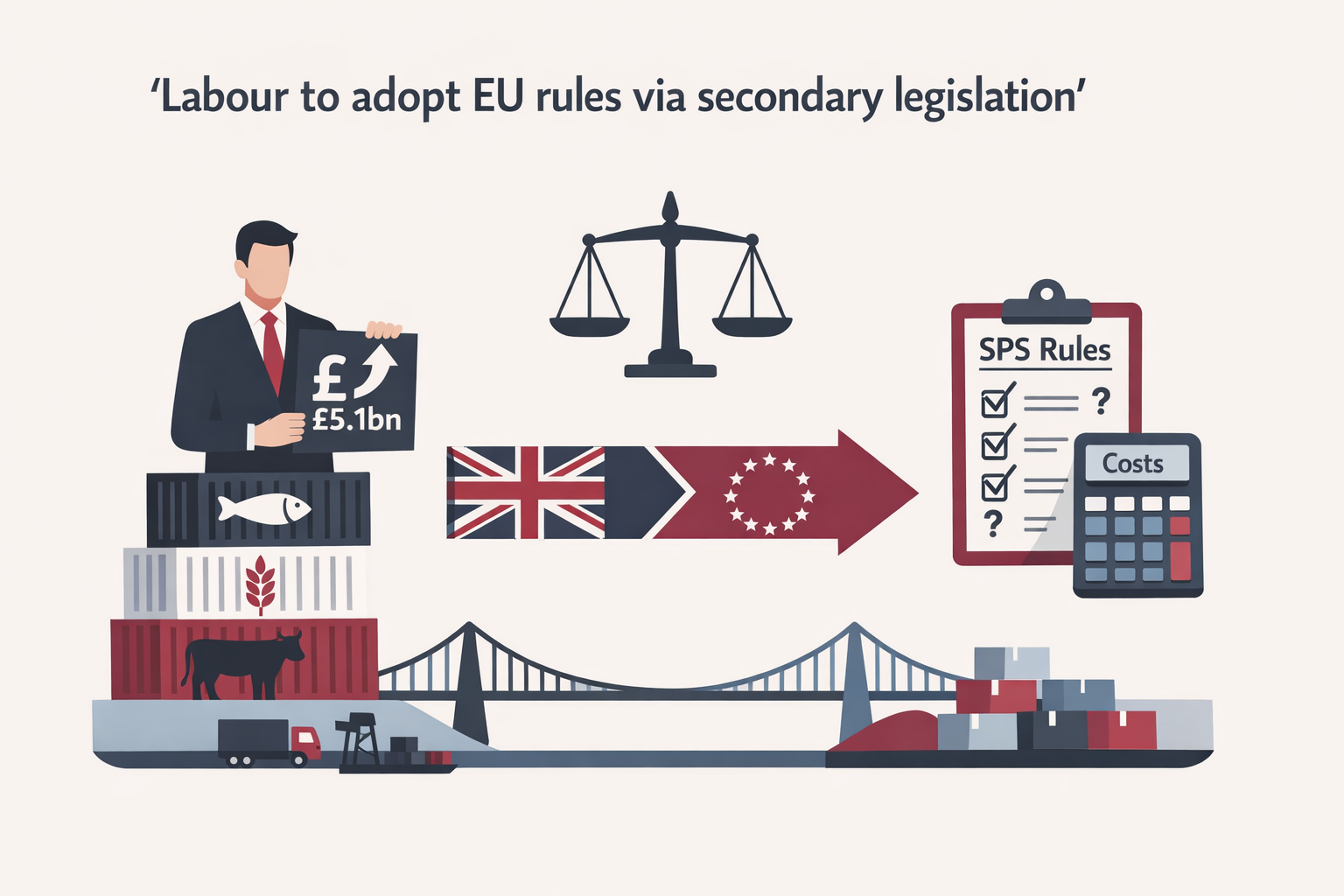
Ministers are preparing legislation that would let the UK adopt evolving EU single market rules in areas covered by new agreements with Brussels, using secondary legislation rather than full Acts. In Whitehall this is being framed as “dynamic alignment” and-critically for scrutiny-implementation would proceed via statutory instruments, not primary legislation with amendable Commons stages. (theguardian.com)
Downing Street says this is about lowering costs that piled up after Brexit, starting with a long‑trailed sanitary and phytosanitary (SPS) pact for food and drink. The government’s own publicity has attached a headline figure of up to £5.1bn a year for the economy, with savings such as removing most routine checks and export health certificate requirements. That sits alongside EU authorisation to negotiate SPS and emissions trading links. (gov.uk)
The accountability gap is obvious. Secondary legislation is hard to amend and rarely fails. The Commons guide notes affirmative SIs almost never fall-none has since 1978-and the majority of SIs follow the negative procedure, becoming law unless actively annulled. If ministers take sweeping Henry VIII powers in a “reset” bill, they can rewrite primary law by SI, shifting the balance from the legislature to the executive. Creditors and shareholders have seen where weak scrutiny leads when rules change faster than businesses can adapt. (parliament.uk)
There is no dispute that border friction has been costly. EU governments have already green‑lit talks on a common SPS area and on linking the UK and EU emissions trading systems. A functioning SPS deal should slash paperwork on agri‑food movements and cut inspection delays that have tied up working capital since 2021-good news for cash‑strained producers and distributors if the savings arrive as billed. (consilium.europa.eu)
But alignment brings obligations as well as relief. The House of Lords European Affairs Committee has opened a formal inquiry into dynamic alignment, warning of significant constitutional and practical implications and preparing for a government “reset” bill later this year. In short: Parliament will be asked to sign off a process that limits its future say. (parliament.uk)
On the shop‑floor of regulation, this is not a toggle switch. The British Retail Consortium is already telling members to expect “a significant task” to re‑align food law across safety, composition and labelling, and says the EU will only ease controls once UK legislation is demonstrably aligned. The government’s own engagement materials point to an indicative list of changes and a push for completion by mid‑2027. That is a long lead time for businesses already battling invoice stretches and tight covenants. (brc.org.uk)
The cash calculus matters. Export health certificates alone can run to about £200 per shipment; removing them could save thousands per mixed‑load lorry and reduce port demurrage. For food manufacturers and wholesalers living off thin margins, those savings flow straight into liquidity. But if alignment moves unevenly, cost benefits may accrue to larger operators first while SMEs absorb re‑labelling, systems and assurance costs upfront. (gov.uk)
Sectoral risk is uneven too. MPs on the EFRA Committee heard evidence that unqualified alignment could squeeze UK farmers on pesticides and plant protection products, and urged carve‑outs and long, phased implementation to avoid cliff‑edge hits to profitability. For creditors assessing farming and food counterparties, that translates into execution risk: savings at the border set against potential input shocks and compliance whiplash. (hansard.parliament.uk)
Devolution adds another moving part. Food standards and labelling are devolved areas, administered through four‑country arrangements, while the UK Internal Market Act hard‑wires mutual recognition across Great Britain. If London aligns at pace but a devolved administration resists on a specific file, businesses could face a patchwork during transition. The recent “Not for EU” labelling concordat shows how politically live this terrain remains. (food.gov.uk)
Ministers argue this is a sovereign choice to cut red tape; critics say it makes the UK a rule‑taker without votes and reduces Parliament to “a spectator while Brussels sets the terms”. That line-voiced by Conservative frontbencher Andrew Griffith-previews a political fight in both Houses, with Reform UK already framing alignment as a betrayal of Brexit. For boardrooms, the more immediate question is not the slogan but the statutory instrument that turns up on your desk. (theguardian.com)
The macro backdrop is plain. The Office for Budget Responsibility continues to judge that the post‑Brexit trading relationship reduces long‑run productivity by around 4% and leaves exports and imports about 15% below the counterfactual. Ministers will say dynamic alignment claws some of that back; opponents will say it trades away control. Creditors should expect policy to chase growth and headline savings, with the detail arriving later. (obr.uk)
What happens next will be rapid but procedural. The Guardian reports the bill could be introduced before the summer, with core SPS and ETS elements likely first, and subsequent EU updates flowing through by SI thereafter. The Lords inquiry and Commons committees will try to pin down how much notice and consultation industry gets before each change. For businesses already stretched by inflation and tight cash cycles, early scenario‑planning on labelling, assurance and supplier terms is not optional-it is survival planning. (theguardian.com)