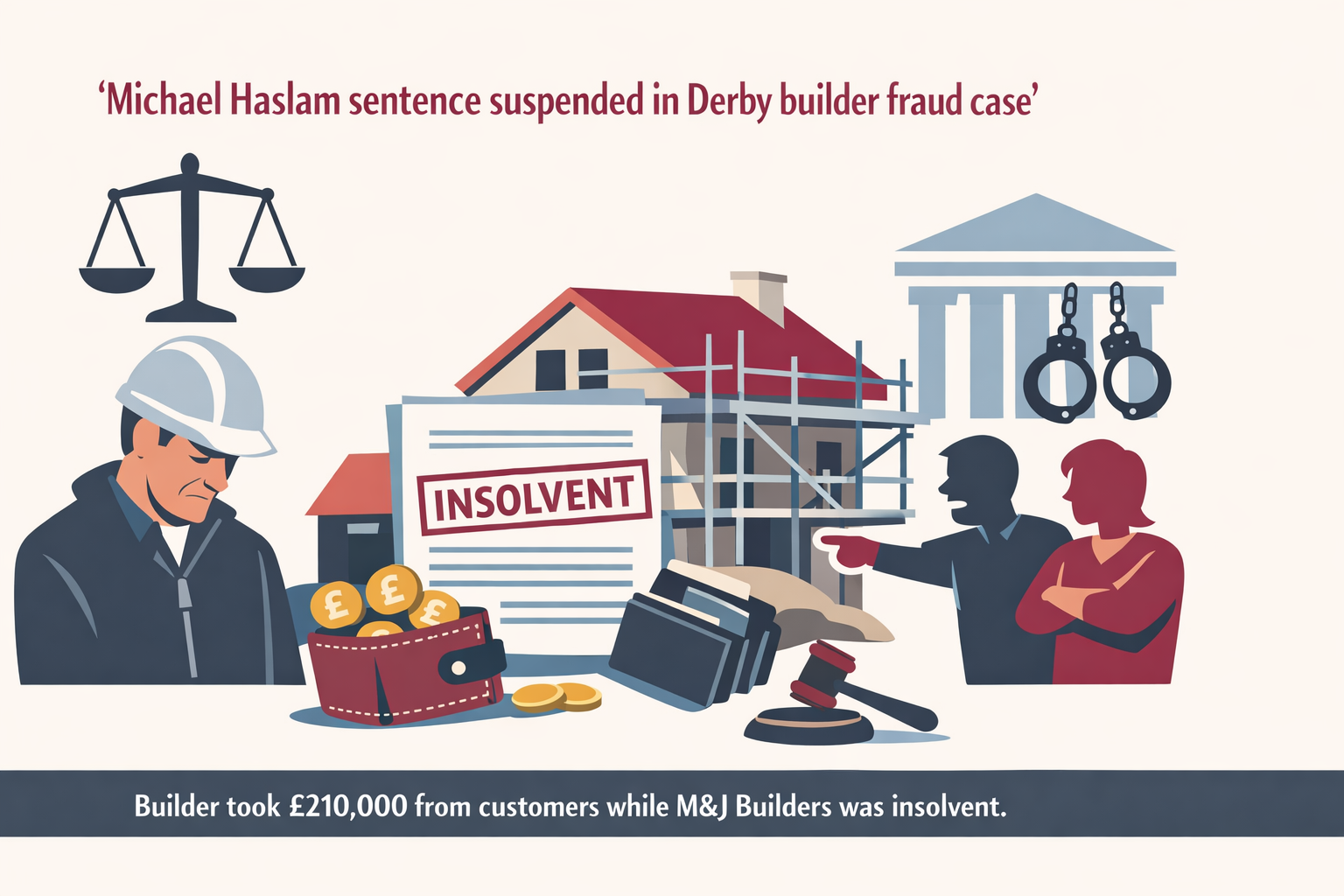
Michael Haslam's case no longer ends with immediate custody. The government release, first published on 2 July 2026 and updated on 26 August 2026, says the Court of Appeal has suspended the 28-month prison term imposed by Derby Crown Court on 1 July. The 74-year-old Derby builder must now serve a two-year suspended sentence, comply with a rehabilitation order and complete 160 hours of unpaid work. That change matters, but it does not alter the conduct underlying the prosecution. Haslam, who ran M&J Builders Limited, pleaded guilty in May 2026 to one count of fraudulent trading after an Insolvency Service investigation found he took more than £200,000 from seven households between 2020 and 2022 when he knew the company was insolvent. The same announcement says he was also disqualified as a director for 15 years, the maximum period available.
This was not a case of a builder missing a deadline and then blaming a difficult job. According to the Insolvency Service, Haslam kept taking money up front from householders after the point when M&J Builders could not pay its debts, then delivered only limited work before sites were abandoned. Customers who had found the firm through adverts in local magazines were left with unsafe structures, unusable rooms, no running water in one home, and repair bills they could not meet. For readers outside insolvency practice, the point is straightforward. Once a company is insolvent, directors cannot go on treating fresh customer payments as a gamble on survival. In ordinary language, fraudulent trading means the business is being carried on dishonestly. Here, the public record says deposits continued to be taken while the company was already bust.
The clearest example came from Darley Abbey. One woman bought a property to renovate for retirement and paid more than £150,000 to Haslam's company in the first half of 2021. The Insolvency Service says she received around £40,000 worth of work. A promised site manager never appeared, work stopped in July 2021, and the property was left unfinished and strewn with waste. She then had to find another £18,000 simply to clear the site before a replacement builder could step in. Her account strips away any attempt to dress this up as a commercial setback. She described losing not only money, but the retirement she had planned. For creditors and consumers alike, that is the real cost of dishonest trading: it lands first on the people least able to spread the loss.
A second victim in Allestree paid £47,760 for a single-storey extension and garage refurbishment. Work stopped in June 2022. When Haslam briefly returned the following month, he demanded another £6,600 to restart the job. She paid. No further work followed. The family was left without running water for seven months and, according to her evidence, continued to uncover dangerous defects long after Haslam had gone. The details are difficult to dismiss as mere poor workmanship. She described steelwork that could not safely bear the load of the house, placing a toddler's bedroom at risk, and raw sewage flowing on to the patio on New Year's Eve. Another Allestree customer paid £12,080 in advance for a kitchen renovation, only for work to stall with windows and doors paid for but never ordered. The remedial work had to be funded through extra borrowing on the mortgage.
Two more households in Mickleover tell the same story of upfront payments, excuses and unfinished work. One family agreed an £18,300 quote in March 2022, endured months of delay, then discovered a window they had paid for had not even been ordered despite being told manufacturing problems were to blame. Council inspectors later warned that part of the extension might need to be demolished altogether, a devastating conclusion for a family that had already taken out a loan to fund the project. Another customer, a mental health nurse, signed a £32,100 contract just days after Haslam had been professionally advised that his company was insolvent. She ultimately paid £35,880 after being told weekly payments would speed the work up. Doors and windows invoiced in May were never installed, and the family was left without a safe fire exit or secure door. They borrowed from relatives to pay for security cameras simply to feel safe in their own home.
If the victim accounts explain the human harm, the banking evidence explains why the Insolvency Service treated this as a fraudulent trading case. Investigators traced almost £400,000 leaving M&J Builders Limited's business account under the reference "MG Haslam Expenses". A £75,000 loan paid into the company in October 2020 had gone within weeks. They also identified £63,055 in cash withdrawals from the business account. The personal account picture was equally stark. The Insolvency Service says it found £164,229 in cash withdrawals, nearly £19,000 spent on Amazon and eBay, and £77,376 paid to Haslam's daughter. Some customers had been told to pay into that account. The announcement also records cash being withdrawn from the business and personal accounts within minutes of each other at the same cash machine. Taken together, that is not the profile of customer money being preserved for subcontractors, materials or completion of works.
There are two separate sanctions here, and readers should keep them distinct. The criminal sentence has been reduced on appeal from immediate custody to a suspended term with unpaid work and a rehabilitation requirement. The disqualification, by contrast, is a civil protection measure. A 15-year ban is the most serious restriction the authorities can impose on a director without a further criminal case, but it does not return a penny to the families left out of pocket. Mark Stephens, the Insolvency Service's Chief Investigator, said fraud is not a victimless crime. On the victim evidence in this case, that is hard to dispute. The government statement puts the losses at about £210,000 across seven victims, yet says nothing about compensation, confiscation or any realistic route to recovery. For those households, accountability is only partial unless it is matched by redress.
The other unanswered point is why the Court of Appeal suspended the prison sentence on 26 August 2026. The update confirms the result, but not the court's reasoning. That omission will trouble victims who were told on 1 July that Haslam's conduct justified 28 months in prison, only to learn weeks later that immediate custody had fallen away. What remains beyond dispute is the pattern set out by the Insolvency Service and admitted by Haslam in his guilty plea: M&J Builders Limited, company number 09943727, kept taking money when it was insolvent, while households were left with derelict rooms, unsafe structures and debts of their own. Inside Corporate Insolvency readers will recognise the wider lesson. Insolvency abuse is rarely confined to the balance sheet. By the time the state intervenes, the damage has usually spread into homes, family finances and trust that does not return quickly.