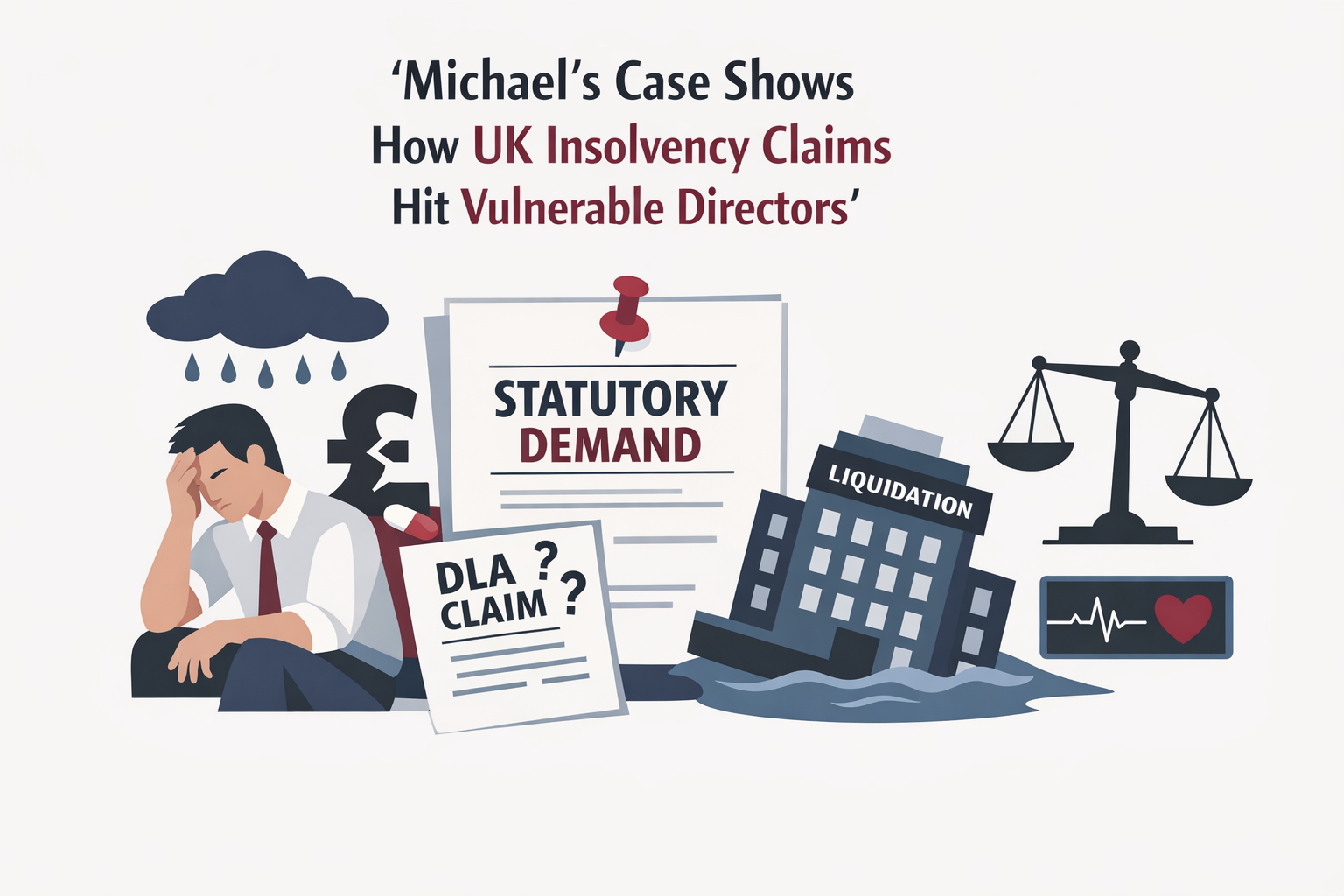
Michael’s case is not about one rogue coffee receipt. It is about what insolvency becomes when a sick individual meets a system built for recovery first and explanation later. The Insolvency Service’s guidance is clear that liquidation is not a tidy wind-down. A liquidator’s job is to realise assets for creditors, and the guide expressly says a liquidator can take action against directors personally for the benefit of creditors. Even where a private-sector insolvency practitioner is appointed, the Official Receiver remains responsible for looking into the company’s affairs. That statutory design matters, because once a business fails the file stops being a trading story and becomes an evidence hunt. (gov.uk)
For a small construction or maintenance firm, that evidence hunt often starts with whatever can be gathered quickly: bank statements, year-end accounts, tax papers and fragments of bookkeeping. HMRC’s own guidance shows why that is a dangerous place to start and stop. A director’s loan account is simply the record of money borrowed from or paid into the company, and HMRC says it can be in credit or debit. Its manual goes further: the account can include dividends, remuneration, business expenditure paid by the director, personal expenditure paid by the company, loans and repayments, and the balance can even sit inside other creditor or debtor balances in the accounts. (gov.uk) That is a long way from the crude shorthand often seen in recovery schedules: money out equals personal benefit equals debt. In Michael’s case, as in many failed owner-managed firms, merchant names on bank statements do not explain whether a spend was fuel for a site visit, subsistence on the road, emergency materials from a supermarket or an actual private drawing.
That is how ordinary trading ends up relabelled as misconduct by spreadsheet. HMRC’s fact sheet says personal expenses paid with company money must be recorded and repaid, but the same body also recognises that a director’s account can reflect a single running balance and that amounts due to and from the company may be kept separately only for bookkeeping reasons. Until the credits, reimbursements, salary votes, dividends and reverse contributions are examined, an overdrawn-looking line can be no more than half a story. (gov.uk) This is where vulnerable individuals are exposed. If records are incomplete, the formal burden may stay on the claimant, but the practical burden lands on the person least able to carry it. Michael does not just have to answer the allegation. He has to reconstruct an old trading life while ill, medicated and under threat.
The same problem appears with orphan balances in old accounts. HMRC’s manual says the year-end balance on a director’s loan account may be specifically identified or may appear as part of other creditor or debtor balances. That matters because labels such as other debtors are accounting containers, not proof of personal liability. In a thin file, however, they become convenient anchors for a claim schedule because they look precise before anybody asks what sits underneath. (gov.uk) Creditors should be wary here as well. A recovery built on inference rather than proof can produce an impressive headline number and still have weak litigation value. Estate money can disappear into chasing the easy-looking defendant instead of testing whether the accounting really supports a net debt.
Then comes the pressure machinery. The Gazette’s guide to statutory demands says an individual has 18 days from service to apply to set the demand aside, and that the court will do so if satisfied there is a genuine dispute. That is exactly why the device is so potent in a case like Michael’s: it compresses a messy accounting argument into a short, frightening timetable and forces the recipient to spend money proving there is something to argue about. (m.thegazette.co.uk) The courts themselves have recognised that civil procedure still has unfinished business when capacity is in issue. On 11 November 2024, the Civil Justice Council published its final report on mental capacity in civil proceedings. Sir Geoffrey Vos said the work was needed to help make the civil justice system more accessible, fair and efficient, and the working group specifically highlighted litigants in person and parties who do not engage with the assessment process. Michael’s position sits squarely in that uncomfortable territory: a person who may be capable on paper, yet not capable of coping with compressed litigation in practice. (judiciary.uk)
This is not a theoretical complaint. In Haworth v Cartmel and HMRC, as summarised by Mental Health Law Online from the High Court decision, a bankruptcy order was challenged on the basis that the applicant lacked capacity to respond to the statutory demand and petition. In Re Hunt, 39 Essex Chambers reports that a bankruptcy order against a man with Huntington’s disease was annulled and the judge was sharply critical of the authority’s approach to his participation in the proceedings. (mentalhealthlaw.co.uk) The Local Government and Social Care Ombudsman gives equally troubling examples. Its bankruptcy fact sheet records a case where a council made a woman bankrupt even though she had mental health difficulties and could not conduct her own affairs, and another where a council pursued bankruptcy against a woman with untreated mental and physical health problems after she had said she was terminally ill. In the second case, the Ombudsman found fault in the council’s failure to make proper enquiries and keep clear records of how it decided bankruptcy was appropriate. (lgo.org.uk)
Public bodies already know what safer practice looks like. Tower Hamlets Council’s current debt strategy says vulnerability should always be considered and that all reasonable efforts must be made to ascertain whether a debtor is vulnerable before insolvency proceedings begin. Telford & Wrekin’s 2025 corporate debt recovery policy says potential vulnerabilities must be assessed before further action and recognises the need to halt recovery during a breathing space, including a mental health crisis moratorium. These are not radical ideas. They are basic controls designed to stop enforcement outrunning common sense. (towerhamlets.gov.uk) In Michael’s case, those controls vanished once the claim moved from office-holder review to a commercial recovery pipeline. The paperwork remained. The illness became something for the recipient to manage privately while the deadlines kept coming.
Money and Mental Health’s research helps explain why this matters. Its Debts and despair report says 24 per cent of people who had missed payments were contacted by creditors every one to two days, while nearly half said the volume of contact left them feeling harassed or overwhelmed. The charity’s 2020 Need to Know guidance says half of people in problem debt also have a mental health problem and urges collections staff to adapt support rather than default to intrusive evidence demands. Parliament has already accepted the need for a pause in some cases: the government’s breathing space scheme gives legal protection from creditor action, and a mental health crisis breathing space lasts for the period of treatment plus 30 days. (moneyandmentalhealth.org) For Michael, that translates into a hard practical point. If the debt is genuinely disputed, insolvency should not be used as theatre to frighten a settlement out of a medically vulnerable person. The record needs to be rebuilt properly, communications need to go through representatives, direct pressure needs to stop, and any claimant pushing a statutory demand should be put back to proof.
Creditors should ask awkward questions before they allow that to happen. The Insolvency Service’s own guidance says creditors can seek further information about a trustee or liquidator’s remuneration, and can complain about an insolvency practitioner through the complaints gateway. If a claim against a former director is being pursued in the creditors’ name, creditors are entitled to know what records exist, what assumptions have been made, what health adjustments have been offered and whether the likely return survives legal scrutiny after costs. (gov.uk) Michael’s case strips away the polite language that often surrounds insolvency. For a vulnerable individual, the danger is not only insolvency itself. It is the way the process can turn incomplete records into certainty, illness into inconvenience and fear into a collection tactic. That is the point at which the profession needs scrutiny, not applause.