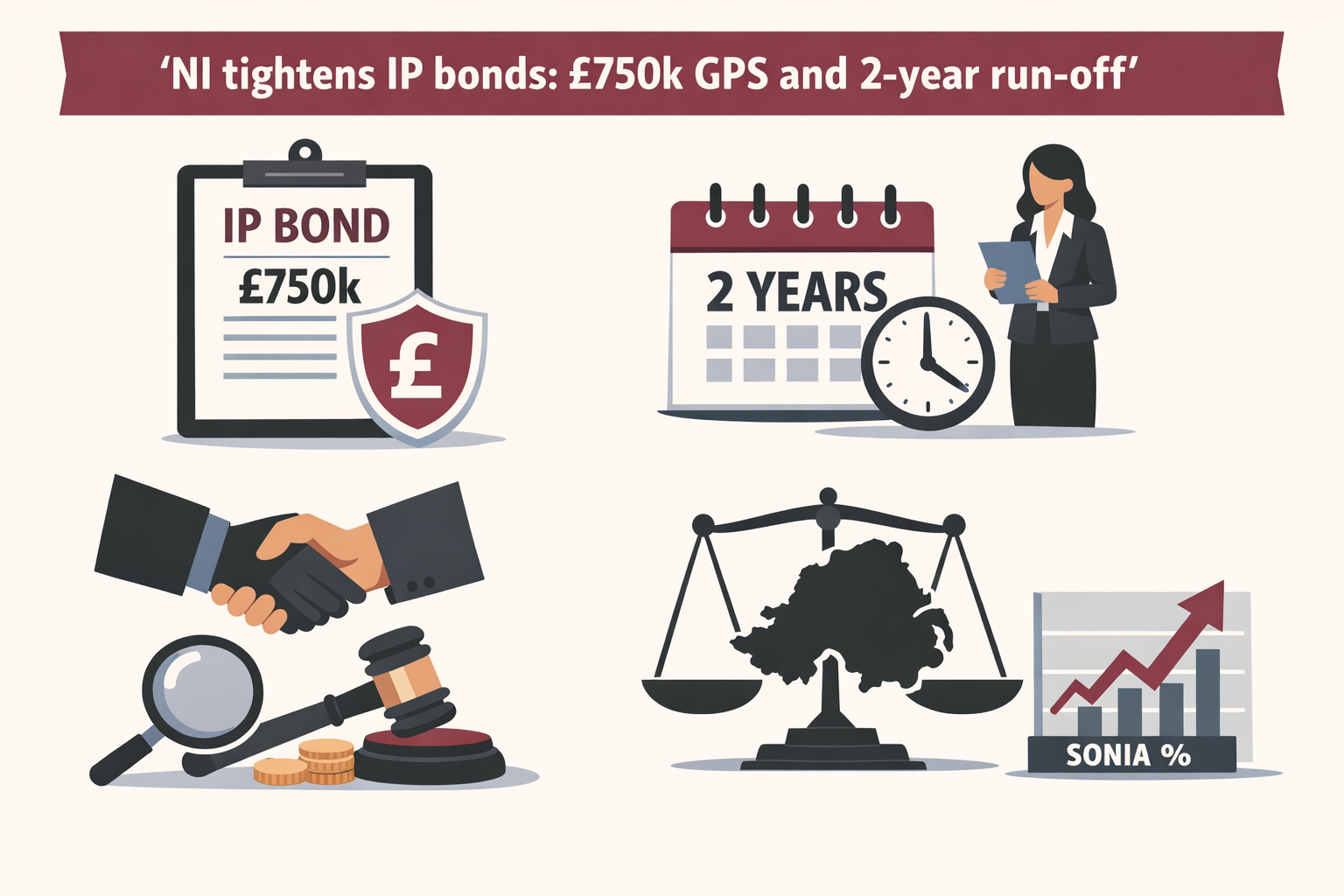
Northern Ireland has overhauled the bonding that insolvency practitioners must keep in force. The Insolvency Practitioners (Amendment and Transitional Provisions) Regulations (Northern Ireland) 2025 were made on 12 November 2025 and take effect on 9 December 2025, amending Schedule 2 of the 2006 Regulations. The instrument was sealed by the Economy Minister, Dr Caoimhe Archibald.
The Department’s move aligns Northern Ireland with reforms introduced in Great Britain last year. Those GB changes raised bond limits, mandated interest on losses and set explicit timeframes for claims, features now replicated in the Northern Ireland rule set. Legislation.gov.uk confirms the underlying 2006 NI framework being amended, while the GB instrument from October 2024 shows the model Northern Ireland has followed.
For readers outside the profession, a bond is the insurance-like security an insolvency practitioner (IP) must maintain to protect an estate against losses caused by the IP’s fraud or dishonesty. It has two elements: a case-specific Specific Penalty Sum (SPS) and a General Penalty Sum (GPS) that can respond where SPS cover is missing or insufficient. This architecture is set out in the Insolvency Service’s Dear IP guidance.
From 9 December, the GPS must be £750,000 and it can now pay where an SPS was never put in place for a case. That closes off a longstanding gap where creditors were left exposed if a practitioner took an appointment but failed to arrange the case bond. The GB rules already require this approach; Northern Ireland’s instrument brings parity.
Interest on proven losses will run at a rate above the Sterling Overnight Index Average (SONIA), calculated from the date the loss occurred until the claim is paid. That matters: bond claims often take months, and without interest, recoveries erode in real terms. The government’s guidance confirms SONIA as the benchmark.
Critically, the bond must now meet reasonable costs of a successor IP who steps in after suspected fraud or dishonesty. That includes investigation costs, the costs of bringing the bond claim, expert advice, and even duplicate administration costs necessary to put right work already charged by the prior office-holder. In plain terms, estates should not pay twice to fix wrongdoing; the bond should.
A minimum two-year run-off now applies after an IP is released or discharged in the case. Where the same practitioner later holds a subsequent office in that case, the run-off clock starts from the final release. Creditors get a defined window to pursue a claim even after the office-holder has exited. This has been standard in GB since December 2024 and is now embedded in Northern Ireland.
If a bond limits the surety’s liability to losses arising within a stated period, the SPS indemnity period must be at least six years from the date of appointment, with the option to extend. Consent to extend cannot be unreasonably withheld, though an extra premium may be sought. Those premiums are a firm cost of practising and should not be charged to insolvent estates. The requirement for a six-year minimum is clear in government materials.
Bond providers must give at least 60 days’ notice to both the IP and the authorising body before SPS cover expires or is cancelled for non-payment. That should reduce quiet lapses in cover. With the Law Society of Northern Ireland stepping away as an RPB this month, timely notice to whatever body now licenses the practitioner is not a formality; it is a safeguard.
Transitional arrangements are generous but time-limited. Bonds issued before 1 January 2027 for cases where the IP was appointed before that date can continue under existing terms, and during the period from 9 December 2025 to 31 December 2026 the Department may approve either legacy or updated bond wordings. Creditors should ask office-holders to confirm, in writing, which regime their case sits under and the precise SPS indemnity period.
Premiums are likely to rise. Trade body R3 has already warned that smaller practices will feel increases most acutely as the GPS triples, with Aon indicating that while it supports the changes, cost pressures on small firms are real. Creditors should be alert to any attempt to pass firm-level bonding costs to estates-push back early and in writing.
What to do now: ask your office-holder for the SPS amount, its indemnity period, and the date any 60‑day notice would bite. Confirm that any successor IP is pursuing bond recovery for investigative and duplicate costs, rather than charging the estate. If fraud is suspected, move fast-the two‑year run‑off runs from release. Document everything, and insist the practitioner’s authorising body is copied on key correspondence.