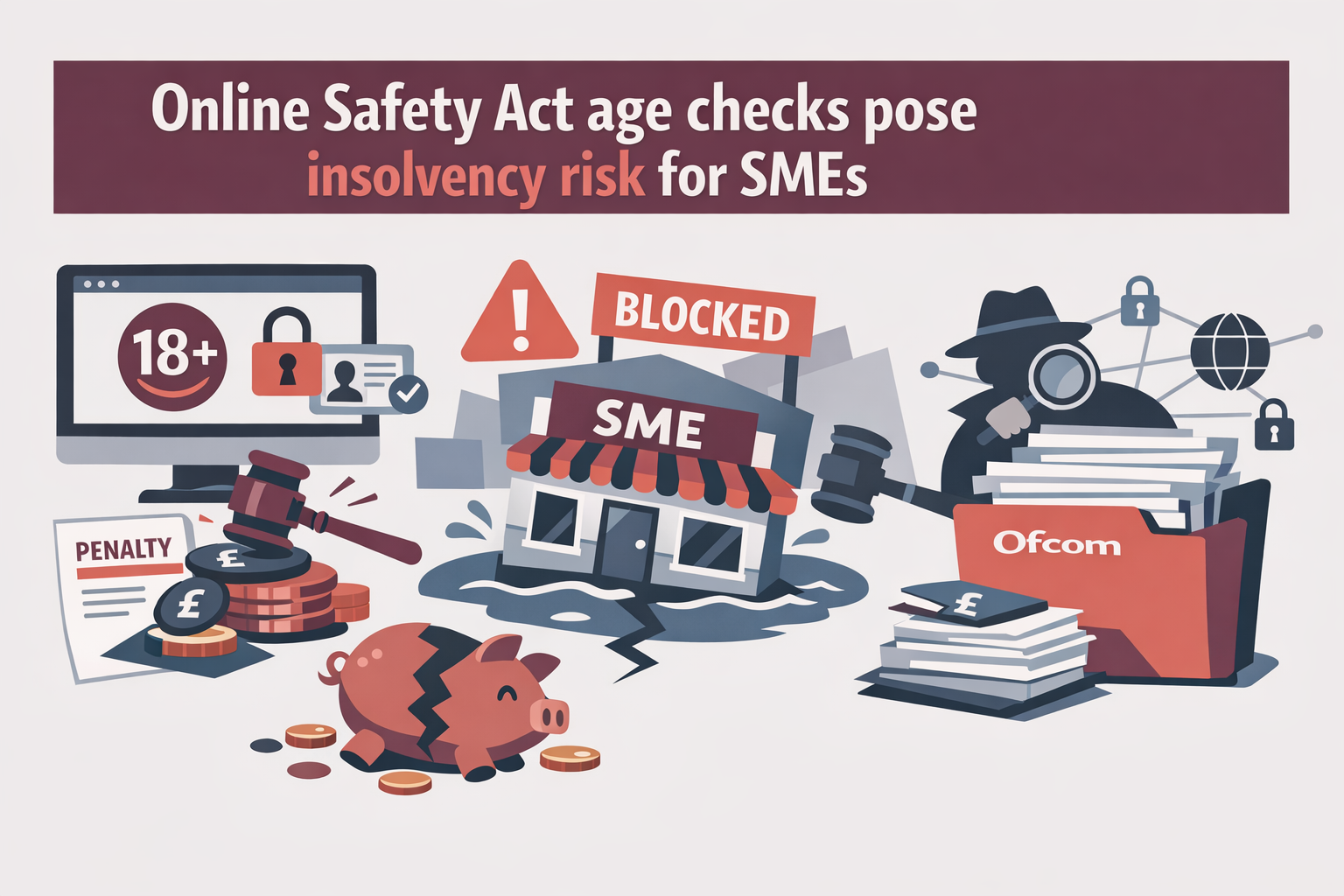
Age‑verification obligations have moved from rhetoric to enforcement. Under the Online Safety Act, platforms likely to be accessed by children must complete risk assessments and implement measures from 25 July 2025, while any service that allows pornography must deploy “highly effective” age checks. Failure invites penalties measured against worldwide revenue and, in severe cases, blocking orders. For owner‑managed platforms, that is a financial and operational hazard with real insolvency potential.
The cash exposure is not limited to fines. Ofcom has confirmed it will fund the regime through fees charged to industry using a qualifying‑worldwide‑revenue basis, with further consultations on how that revenue is calculated. For smaller services with thin margins, regulatory bills that scale with usage risk turning compliance into a going‑concern question.
Enforcement is already biting. Ofcom fined AVS Group just over £1m for inadequate age checks across 18 adult sites and added a further penalty for failing to answer information requests. Separately, a file‑sharing service was fined £20,000 for ignoring statutory notices and faces daily penalties. Beyond monetary sanctions, courts can grant service‑restriction and access‑blocking orders-existential threats for any UK‑facing platform.
Regulators are scaling up investigations. Since July, Ofcom has opened cases into groups operating 34 and then 22 pornography sites, while stating that top destinations have introduced checks for UK users. This momentum signals more confirmation decisions, more penalties and, for weaker balance sheets, a faster route to administration.
Revenue is already under pressure. Industry reporting shows a sharp slump in UK traffic to major adult sites after age checks were introduced, alongside a surge in VPN downloads. Friction means fewer UK views, fewer conversions and thinner cashflow-exactly the conditions that push advertisers, hosts and creators into arrears.
Compliance is technically demanding. Ofcom expects age‑assurance systems that are accurate, robust and fair, typically through facial age estimation, photo‑ID matching or checks via banks or mobile networks. In parallel, the ICO’s Children’s Code remains in force, with live enforcement and a March 2025 update noting one video platform had exited the UK market. Layered regimes multiply vendor contracts, liability and cyber risk-costs that smaller companies struggle to carry.
Government material suggests per‑check prices can be pennies at scale, but volume fees, integration work, security controls, legal advice and product redesigns quickly compound into five‑ and six‑figure annual spends. For bootstrapped firms, that is the difference between meeting payroll and a CVL.
The timetable has been relentless: illegal‑harms duties kicked in from March 2025; more than forty child‑safety measures were laid before Parliament in April; children’s assessments and risk mitigations followed by mid‑ and late‑July. Services must designate accountable executives and show evidence of proportionate controls. Non‑compliance now lives on the balance sheet.
Directors are already choosing between costly compliance, UK geoblocking or withdrawal from the market; Ofcom itself noted thousands opted to implement age checks rather than restrict access, yet exits have occurred under related children’s‑privacy rules. Each choice has creditor consequences, from declining receivables to broken advertising and hosting contracts that end up in proofs of debt.
For suppliers-ad networks, creators, cloud hosts, moderators-the warning lights are late payments, sudden traffic drops and requests to stretch terms. Those are classic precursors to CVLs and pre‑packs in digital media. Early engagement on repayment plans and, where necessary, fixed‑charge control over key assets can mitigate recoveries risk for unsecured creditors.
Sector data underline the fragility. While overall insolvencies eased off 2023’s peak, the Information and Communication sector recorded an 8% rise in 2024 versus 2023, showing how exposed digital businesses remain to external shocks. The Online Safety Act adds a new, non‑negotiable cost centre to that picture.
Civil society is mobilising. The Electronic Frontier Foundation has launched an Age Verification Resource Hub arguing that sweeping age‑gating creates surveillance risks and barriers to lawful speech. Whatever one’s view, directors must plan for the law as written-and as enforced. Those who delay risk not only fines and blocking orders but the swift move from cash squeeze to formal insolvency.