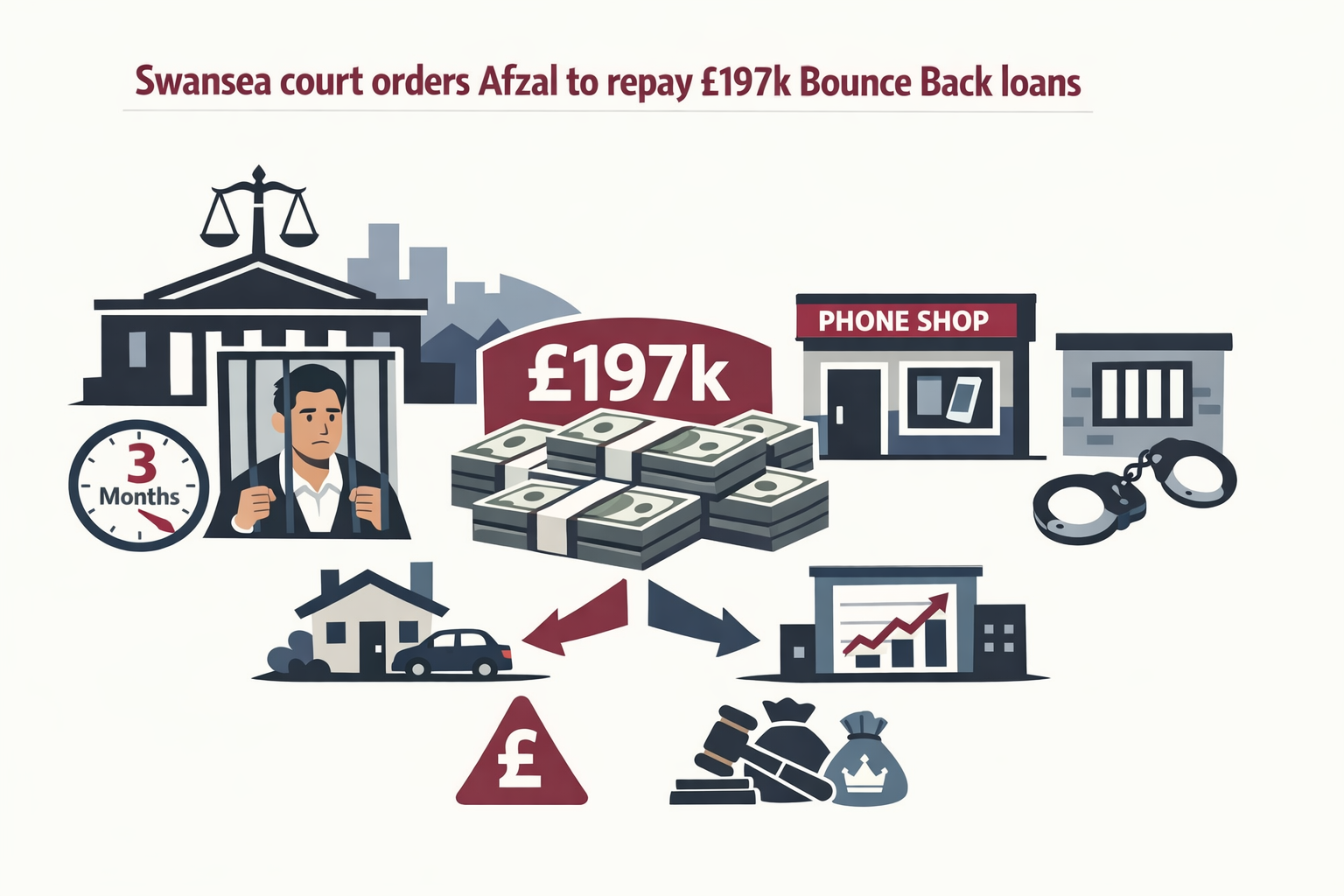
Swansea Crown Court has ordered mobile phone shop director Zahid Afzal to repay £197,306 within three months after admitting he still had Covid Bounce Back Loan cash. If he fails to pay, he faces two years in prison. The figure exceeds the £150,000 he wrongly obtained, reflecting indexation since 2020. The order was made on Monday 19 January 2026 following an Insolvency Service investigation. (gov.uk)
Court documents cited by the Insolvency Service outline a straightforward pattern: after two legitimate loans totalling £52,500 for Phone Bits Limited and Phones Onn Ltd, Afzal secured three further maximum-value loans by falsely declaring no previous borrowing and inflating turnover. Significant sums were then moved from company to personal accounts, contrary to scheme rules that funds be used only for the economic benefit of the business. (gov.uk)
This confiscation follows Afzal’s earlier sentence at Swansea Crown Court in June 2025-two years’ imprisonment, suspended for two years, plus 300 hours of unpaid work-after he pleaded guilty to fraud by false representation. Today’s order converts that judgment into hard recovery with a tight three‑month clock. (gov.uk)
Investigators also obtained a restraint order under the Proceeds of Crime Act 2002, freezing Afzal’s accounts to stop dissipation ahead of confiscation. That step matters operationally: it preserves assets but can also trap trading funds if a company later enters formal insolvency, requiring careful liaison between any office‑holder and prosecutors to avoid breaching the restraint. (gov.uk)
Two points on who ultimately benefits. First, compensation to identified victims takes precedence over confiscation where the court makes both orders. Second, where there is only a confiscation order-as here, no compensation order is mentioned-the money is paid to the Crown and redistributed under the Asset Recovery Incentivisation Scheme among agencies including HMCTS, CPS and investigating bodies. That does not automatically route funds back to lenders unless they are named for compensation. (gov.uk)
Both Afzal companies remain active at Companies House as of 19 January 2026-Phone Bits Limited (10136495) and Phones Onn Ltd (11771257). No insolvency proceedings are recorded. This recovery has been achieved without a winding‑up petition or appointment of an insolvency practitioner, underlining the state’s readiness to use criminal asset recovery where it can move faster than corporate procedures. (find-and-update.company-information.service.gov.uk)
For insolvency practitioners, the takeaway is procedural. If a restraint order predates a winding‑up order, property caught by the restraint is excluded from the estate and cannot be realised without a court‑ordered variation. The official receiver or liquidator should notify the prosecuting authority, keep the case under review and, where appropriate, apply to vary the restraint to meet necessary trading or estate costs. Any surplus after satisfying confiscation can flow back to the estate. (gov.uk)
If insolvency arrives before restraint, POCA powers cannot be used against property comprised in the estate. A confiscation order can still be made against the convicted individual, but enforcement cannot bite on assets already caught by the insolvency regime. That distinction has practical consequences for creditors expecting repayment from seized cash and for IPs planning realisations under court‑imposed timelines. (gov.uk)
The Bounce Back Loan rules are clear: one loan per company, capped at £50,000, not for personal use and repayable over six or ten years. Afzal’s conduct cut across those terms-false declarations and personal transfers-which is why confiscation has now followed the suspended sentence. For lenders and taxpayers, the case shows the value of early scheme‑breach detection combined with asset restraint. (gov.uk)
Zooming out, this order lands against a backdrop of rising asset recovery receipts across England and Wales, with the Home Office reporting £284.5 million recovered in the year to March 2025, driven by improved confiscation performance. The message for directors who misused Covid support is unambiguous: criminal recovery is accelerating and repayment (indexed where appropriate) will be pursued. (gov.uk)