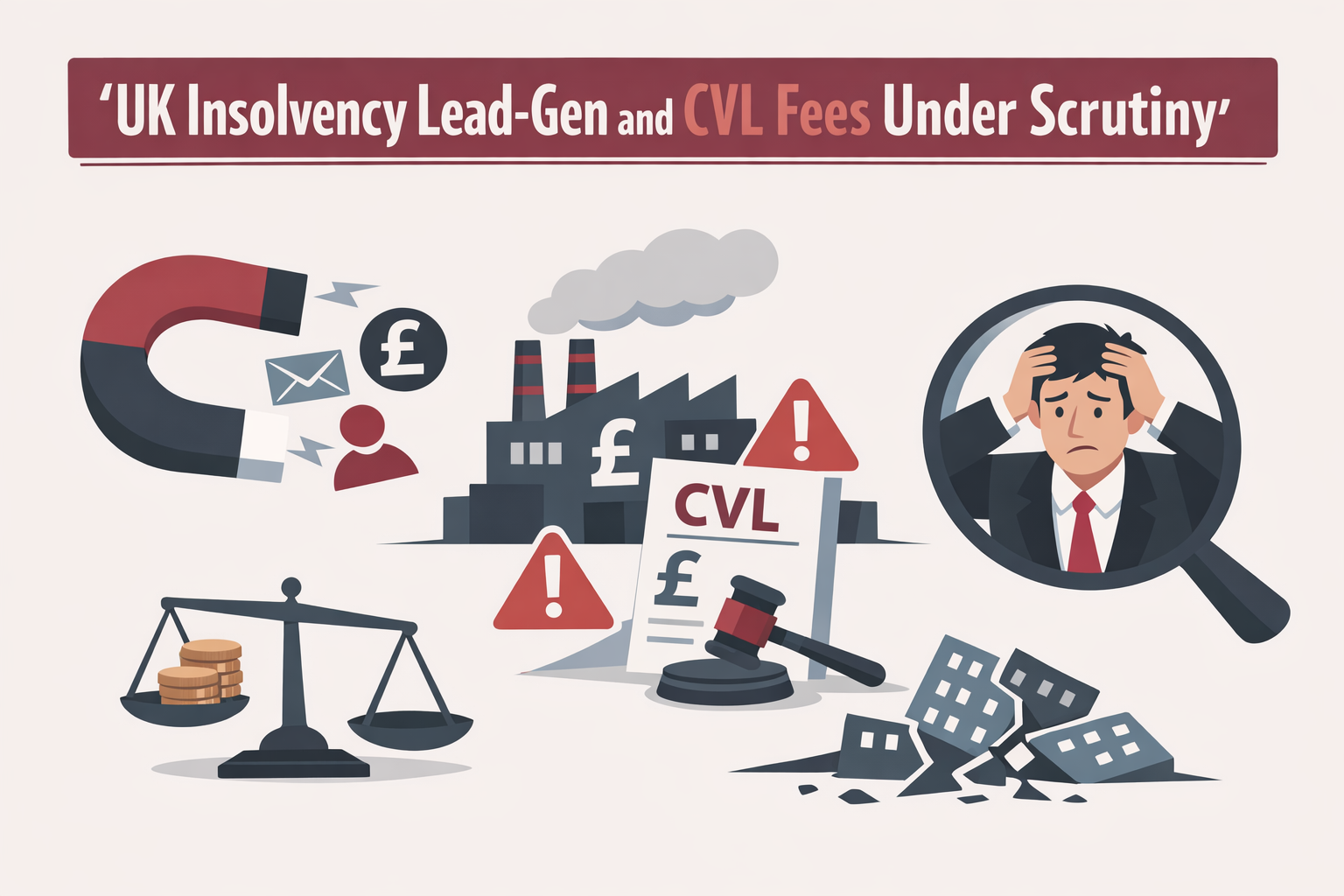
Strip away the profanity in the source copy and the allegation still lands with force: a director searching for help can be met first by marketing dressed up as neutral guidance. The Insolvency Service’s own advertising guidance warns about lead generators using claims such as ‘Government backed’, ‘free’ and ‘immediate’ solutions, using official logos, and suggesting that insolvency practitioners work for a business when they do not. It also says the practitioner remains responsible for the marketing of third parties from whom appointments are taken. That is not an outsider’s rant; it is the regulator describing a problem inside the market itself. (gov.uk) What cannot be missed is the target audience for that marketing. It is the director at the point of panic, relying on search results and polished copy to tell the difference between independent guidance, a lead generator and a firm seeking an appointment. Official guidance does not quantify how often those encounters end in a creditors’ voluntary liquidation, or CVL, but it does establish the conditions in which branding, introducers and sales language can shape the route a distressed director takes. (gov.uk)
The harder question is not whether bogus websites exist; both government and the Insolvency Practitioners Association have said they do. The IPA has warned that practitioners’ names have been unlawfully added to websites to get around Google’s restrictions on lead generators. The Insolvency Service, meanwhile, shut down the Atherton companies after finding they had marketed themselves as ‘a legal alternative to using insolvency practitioners’ while misleading directors about debts, assets and future liability. (insolvency-practitioners.org.uk) That matters because it blurs a line many directors assume is clear. The public sees different trading names, different websites and different scripts. The profession sees introducers, referral arrangements and a compliance framework that still depends heavily on policing the route by which work reaches the office-holder. Where ownership, brand history and introducer links are opaque, the information advantage sits with the seller, not the director or the creditor. That final point is an inference drawn from the regulator’s own concern with introducer due diligence and misleading branding. (gov.uk)
Since the Insolvency Act 1986, the UK has relied on recognised professional bodies to authorise practitioners rather than a single state licensing regime. The Secretary of State recognises those bodies, and the current regulated professions register says practitioners are authorised and regulated by one of four recognised professional bodies, each responsible for its own disciplinary and compliance arrangements. That is the structure sitting beneath all the industry language about standards and independence. (gov.uk) The accountability figures are less reassuring than the profession often suggests. In 2024 the Insolvency Practitioner Complaints Gateway received 656 complaints, but only 144 were referred on to the recognised professional bodies. In the same annual review, published sanctions totalled 46 at the IPA, 16 at ICAEW and 1 at ICAS. Those numbers do not prove a failed regime on their own, but they do support a fair public question: why does a profession handling compulsory investigations, director reports and creditor recoveries still answer so much of its discipline through member bodies. (gov.uk)
When the sales pitch ends and the formal process begins, the economics are awkward. The Insolvency Service’s CVL research, published on 17 December 2024 and based on 2,717 completed CVLs that started in 2017, found that 83% of cases included pre-appointment fees and that the median pre-appointment fee was about £4,000. The same study found a median total cost equal to 163% of estate value, a median recovery rate of 0% for all creditors and no payment to any class of creditor in 86% of cases. (gov.uk) Those figures need to be handled carefully. They do not show that every liquidator is overcharging, or that every liquidation should have been avoided. The Insolvency Service itself notes that realisable assets were very low in most of the files reviewed. But the numbers do show why creditors are entitled to ask what exactly is being protected when a procedure sold as orderly resolution so often produces no return, while still carrying material pre-appointment cost. (gov.uk)
The official data also punctures one of the market’s most useful myths: that appointing a licensed liquidator is, by itself, a shield for directors. The CVL research states that once a company enters formal insolvency, the appointed office-holder has a legal duty to report director conduct to the Secretary of State. In the sampled CVLs, 54% of cases were sifted in as in scope for investigation, 19% were targeted for investigation, and 49% of those targeted ended in a disqualification outcome, equivalent to 5% of the full dataset. Professor Andrew Keay of the University of Leeds described section 214 wrongful trading as ‘not representative of good regulation’, even while accepting that some prohibition on wrongful trading can be justified. (gov.uk) The wider enforcement picture is hardly marginal. The Insolvency Service’s 2024-25 annual report recorded 1,037 director disqualifications, 118 compensation orders or undertakings worth £3.6 million, and 169 criminal prosecutions, with the average disqualification length at 8.3 years. Its 2026 to 2031 enforcement strategy then restated the point in policy terms: formal insolvency cases remain a substantial source of investigations and enforcement work. A director entering CVL may be seeking closure; the state sees a conduct report, and sometimes a target. (gov.uk)
This is where ordinary trading decisions can be recast after the event. The Insolvency Act’s misfeasance provision allows the court to examine directors who have misapplied company money or property or breached duty in the winding up. Official receiver guidance gives examples including improper payment of company money. Government guidance and the CVL research glossary also spell out preference and transaction-at-undervalue claims: payments or transfers that improve one creditor’s position over others, or move value out of the company for less than it is worth. (legislation.gov.uk) Precision matters here. Buying coffee for staff is not automatically misconduct, and neither is repaying mileage or choosing one supplier over another. But once a company fails, routine transactions can be reopened through insolvency law if the timing, the recipient or the company’s financial position makes them vulnerable to challenge. Official guidance points to a two-year period for transactions at an undervalue and a six-month or, for connected persons, two-year period for preferences. For small company directors with patchy records, that is more than a technical rule; it is a retrospective audit of choices made under pressure. (insolvencydirect.bis.gov.uk)
The source article’s central complaint, once stripped of slogan and rage, is that too much of this market still works in darkness. Government has known for years that misleading lead generation exists, that practitioners can obtain work through introducers, and that the profession is largely authorised and disciplined through recognised professional bodies first established under the 1986 settlement. Yet directors in distress still meet a screen full of reassuring brand names long before they meet a creditor, a judge or a regulator. (gov.uk) Inside Corporate Insolvency’s question is therefore narrower, and sharper, than the original rhetoric. Not whether fraudsters and sham rescue schemes exist; official action against Atherton answers that. The real question is why a market that can take pre-appointment fees, produce nil creditor returns in most sampled CVLs and trigger formal conduct reporting for every appointment is still allowed to sell itself to distressed directors in the language of rescue first and scrutiny later. (gov.uk)