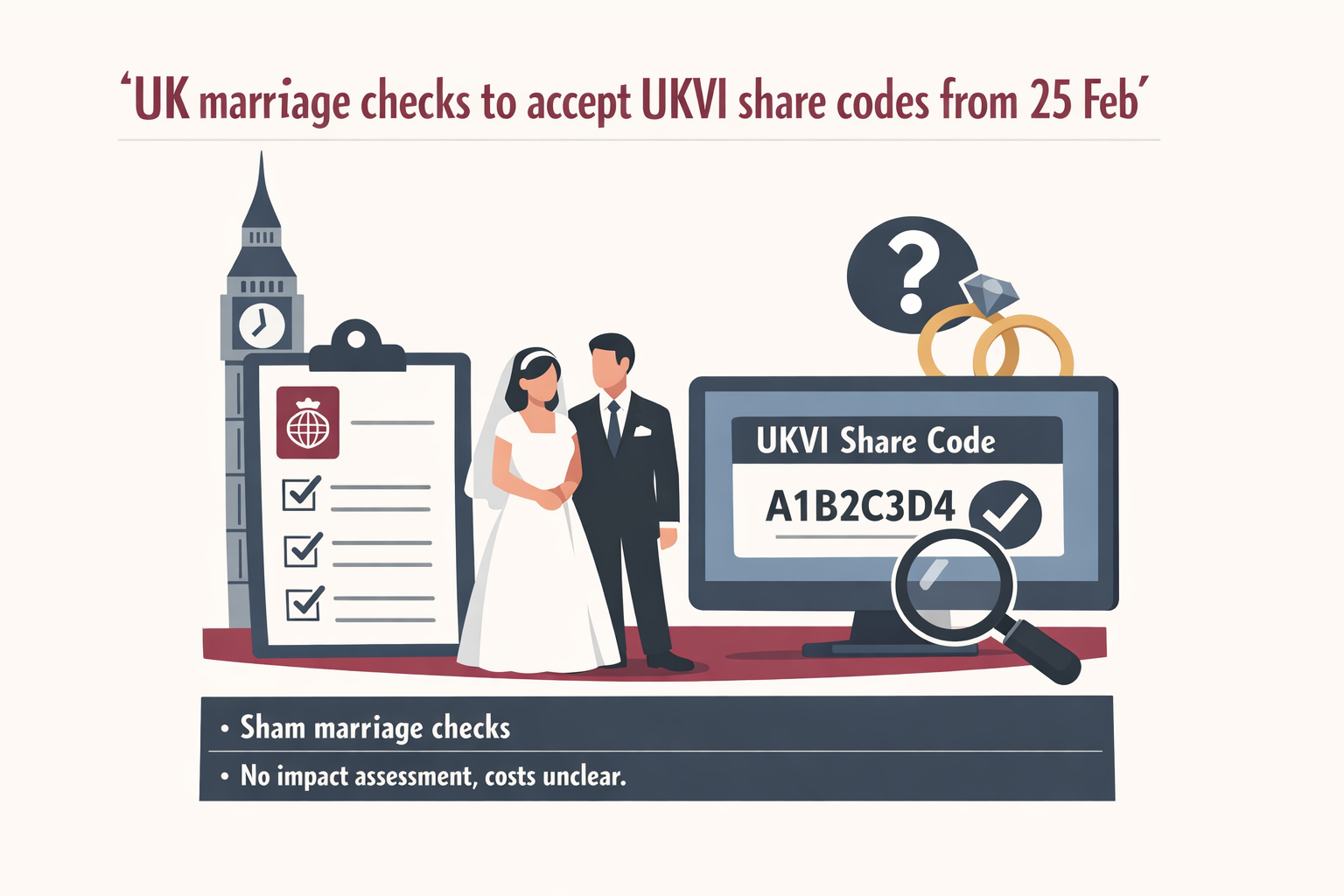
The Home Office has laid new regulations that switch part of the sham marriage referral process onto digital rails. From Wednesday 25 February 2026, registration officers across the UK will be able to use a UK Visas and Immigration (UKVI) ‘share code’ to confirm when a party is exempt from immigration control, instead of relying solely on paper letters. The measure sits within the existing referral-and-investigation scheme, which remains in force UK‑wide. (gov.uk)
What actually changes is the evidence a party can provide at notice. The instrument amends Schedule 1 of the 2015 Referral Regulations so that, as an alternative to a Home Office letter, the notice can be accompanied by the person’s date of birth and a valid share code granting the registrar time‑limited access to the individual’s online UKVI account. That account must show a digital record confirming exemption from immigration control for the purposes of section 49 of the Immigration Act 2014. (legislation.gov.uk)
Parallel amendments are made for Scotland and Northern Ireland, with the definitions of “online UK Visas and Immigration account” and “share code” set out so registrars have a common digital route to check status regardless of where the ceremony is to take place. The drafting mirrors the Scotland and Northern Ireland administrative regulations first made in 2015. (legislation.gov.uk)
None of this alters the core referral scheme mechanics. Where a case is referred and the Home Office decides to investigate, the notice period still moves from 28 days to 70 days-an extension that can upend ceremony dates if documents or digital records don’t line up. That timeline remains central to how risk is managed in suspected sham cases. (gov.uk)
The explanatory note to the instrument says no full impact assessment has been produced because no, or no significant, impact is foreseen. Readers of this publication will recognise the pattern: additional checks are introduced while costs and delays are left to be absorbed by councils and couples. Registration services-already stretched-now face live system access checks and follow‑up requests inside appointment windows, with no clarity on funding.
Operationally, share codes are designed to be re‑issued on demand and typically last 90 days. That should limit disruption, but it also assumes UKVI’s digital status is available and accurate at the point of notice. The regulations expressly allow a superintendent registrar to ask the party to generate a fresh code for a specified period if access fails or the previous code has expired. (gov.uk)
Local registration services have already been nudging couples toward digital proof. Haringey Council, for example, tells notice applicants with online status to bring a share code alongside their passport and proof of address-an early sign of practice now formalised by the new instrument. (haringey.gov.uk)
Data handling deserves scrutiny. A share code lets a third party view elements of the holder’s identity and immigration status via UKVI; registrars will need to align retention policies and audit trails with that reality. UKVI’s own guidance confirms third parties will see some personal details when a code is used, reinforcing the need for clear privacy notices at the point of notice. (gov.uk)
Errors are not hypothetical. UKVI directs users to report eVisa mistakes-wrong dates of birth, mismatched status, or an inability to generate a code. If those errors surface at the counter, the investigation clock and venue bookings collide. The Home Office should set out a fast‑track correction route when a ceremony is imminent and the digital record is at fault. (gov.uk)
For context, section 49 of the Immigration Act 2014 defines who counts as an exempt person for marriage referral purposes and empowers the Secretary of State to set evidence rules. The 2015 regulations built the original paper‑based evidence lists; the 2026 update simply brings those lists into the eVisa era without changing who is exempt. (legislation.gov.uk)
Bottom line for readers: from 25 February 2026, registrars can verify exemption from immigration control using a UKVI share code rather than a letter. That should speed straightforward cases, but without a published impact assessment or funding plan, any slippage will land on local authorities, venues and couples-none of whom were consulted on fees. The Home Office needs to explain who pays when the system stalls. (gov.uk)