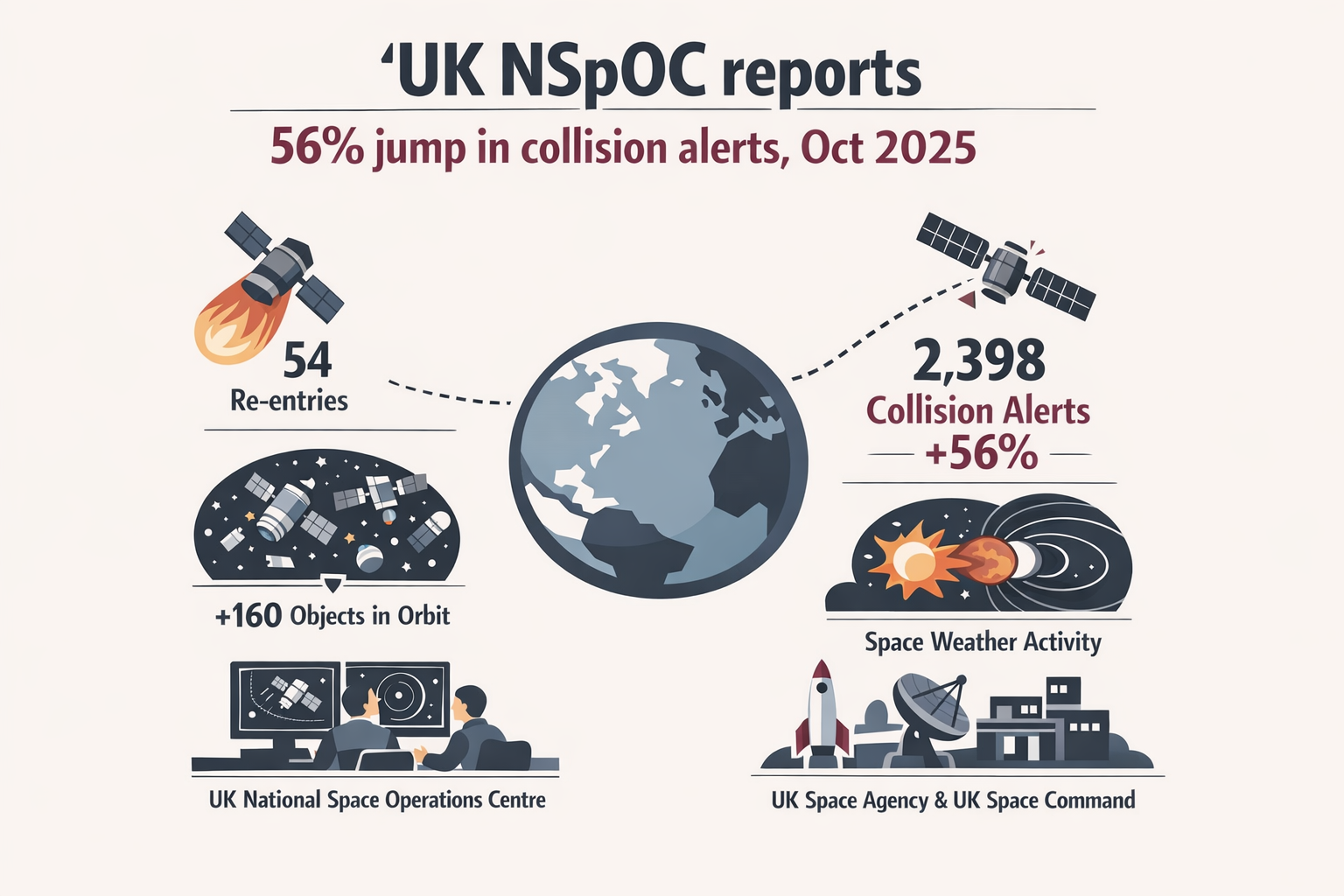
The government’s monthly space safety bulletin, issued on 14 November 2025 for the period 1–31 October, reports a jump in both re-entry activity and conjunction warnings for UK-licensed satellites. The National Space Operations Centre (NSpOC) says all warning and protection services were functioning and that overall risk sat below the 12-month average. The headline numbers, though, raise cost and accountability questions for operators that finance directors and creditors cannot ignore.
On re-entries, NSpOC tracked 54 objects in October-a 15% rise on September’s 39-including 52 defunct satellites and two rocket bodies. Across the last year the monthly count ranged from 34 to 129, placing October in the mid-pack despite the month-on-month uptick.
Collision risk notifications to UK-licensed spacecraft surged 56% to 2,398 in October, up from 1,537 in September. These warnings do not mean collisions occurred, but they do trigger additional analysis and, at times, avoidance manoeuvres that consume fuel and operator time under the UK Space Agency’s Monitor Your Satellites service.
The in-orbit catalogue continued to grow: the US Satellite Catalogue recorded a net increase of 160 Resident Space Objects in October, taking the running total to 31,676. More objects mean more potential conjunctions; the operational burden is drifting upwards even without major break-ups.
October saw no new fragmentation events, but space weather was slightly elevated with geomagnetic storms recorded throughout the month. Storms can degrade tracking and communications, increasing operator workload even when no incident occurs.
Government describes NSpOC as a joint capability of the UK Space Agency and UK Space Command, working with the Met Office to combine civil and military space domain awareness. It issues collision and re-entry alerts and periodically contracts industry to expand capacity, yet the monthly bulletin offers no service-level measures-no alert latency data, no false-positive rates, no proportion of active UK-licensed satellites registered to receive warnings. The UK Space Agency’s 2023–24 annual report says the collision-avoidance service protects 92% of UK-licensed satellites and 100% of those in the most congested low-Earth orbits; if that is the coverage, there is no reason these performance figures cannot sit alongside the headline counts.
Costs flow from these alerts. Each avoidance burn shortens a spacecraft’s life by using finite propellant, while repeated planning cycles pull staff from revenue-generating work and push up insurance touchpoints. Under the UK licensing regime, operators must carry insurance and accept licence-specific liability limits. The UK Space Agency consulted in September 2023 on moving from a flat €60 million liability cap to variable limits by mission profile-a shift that will shape how boards budget for a higher tempo of warnings.
For creditors and non-executive directors, this data should prompt straightforward requests for evidence: the number of high-severity conjunction alerts per craft, delta‑v spent on avoidance, remaining propellant margins, alert processing times, and whether insurance cover remains adequate at current rates. If management cannot produce clear answers, the rising alert volume is already a financial risk.
Bottom line for October: 2,398 collision warnings, 54 re-entries, a net 160-object increase in the catalogued population, no break-ups, and unsettled space weather. The government says overall risk sat below the 12-month average and that services functioned throughout; the cash cost still lands with operators. We will test November’s figures against these statements and press for transparent service metrics, not just counts.