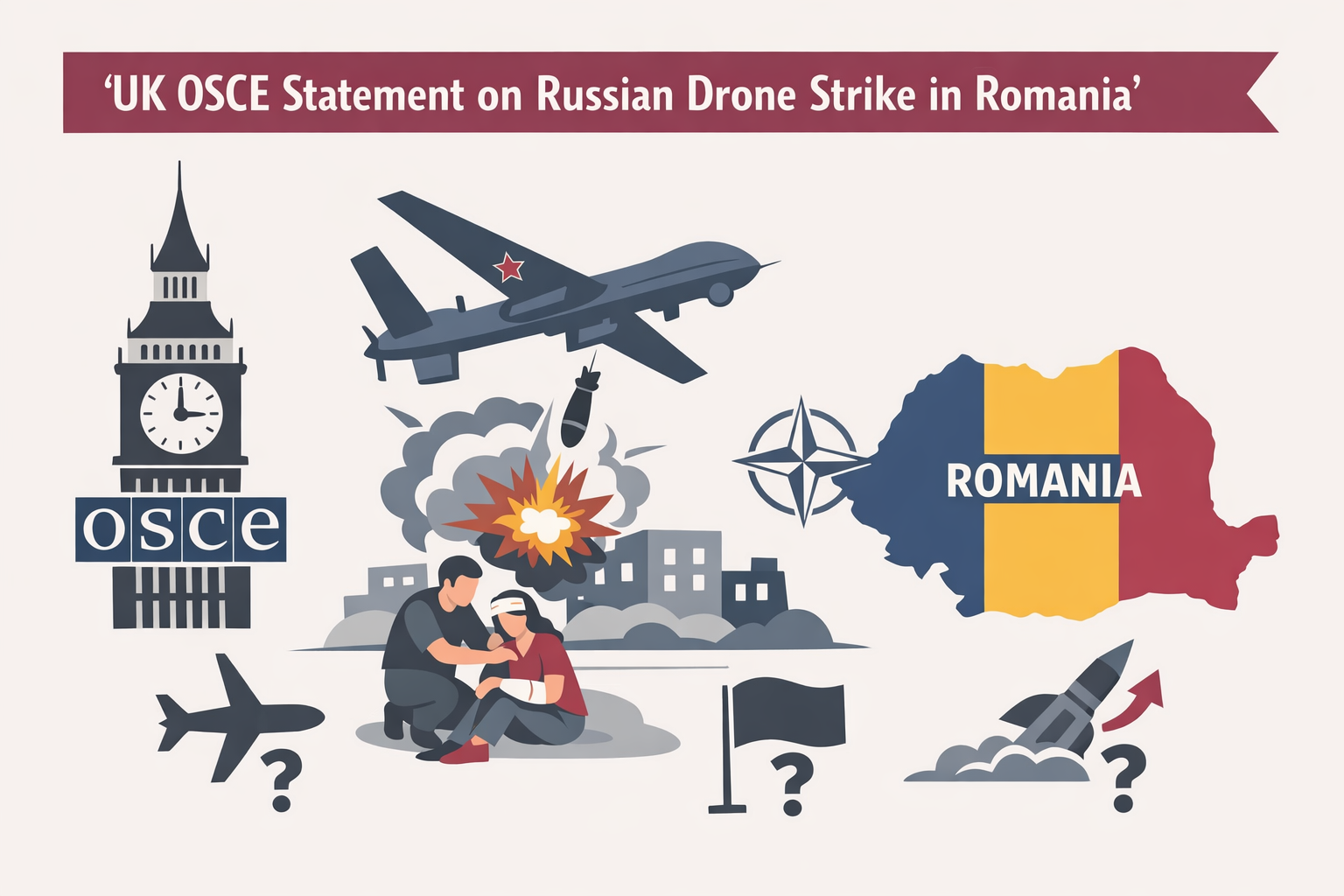
In a statement delivered to the OSCE and published on GOV.UK, the UK government says an armed Russian drone struck a residential building in Galați, Romania, injuring civilians. The wording is direct. London says it stands in full solidarity with Romania, with Ukraine and with those affected by what it describes as Russia’s latest attacks. That matters because the statement is not framed as routine diplomatic sympathy. It presents the incident as a concrete security breach with civilian consequences inside a NATO member state. For a government text, the language is notably plain: civilians were hurt, Romanian territory was hit and the episode is treated as part of the wider danger created by Russia’s war against Ukraine.
The British statement goes further than condemnation. It says the incident was a dangerous violation of Romania’s sovereignty and a serious breach of NATO airspace. It also says the episode cut across the principles of the Helsinki Final Act, the rules meant to limit military risk, uphold territorial integrity and reduce the chance of confrontation through miscalculation. That is the real point of the intervention. The UK is not describing an isolated mishap at the edge of a conflict zone. It is placing the strike inside a broader pattern in which the war against Ukraine is spilling beyond Ukraine’s borders and into allied territory. In other words, the risk is not abstract and it is not confined to the front line.
The statement also leans on OSCE language about predictability, restraint and avoiding actions that could trigger misunderstanding. Those commitments exist for precisely this sort of scenario: a military operation by one state produces an armed incursion into another state’s territory, with civilians caught in the middle. By invoking those commitments, the UK is making a simple challenge. Russia cannot present itself as a participant in risk-reduction dialogue while, according to the British account, its drone operations are injuring civilians in Romania. That tension sits at the centre of the statement and gives it more weight than a standard denunciation.
London also repeats the familiar but important line that NATO is a defensive alliance. The statement says the alliance’s resolve to protect peace and security across allied territory remains firm, and it points to the UK’s continued co-ordination with Romania through Enhanced Air Policing on NATO’s eastern flank. Even so, the incident raises an obvious question which the government text only partly addresses. Solidarity is politically necessary, but readers are entitled to ask what practical protections are in place when attacks linked to Russia’s war can reach a residential building in Galați. The statement offers reassurance on alliance posture, yet the episode itself exposes how thin the line has become between war in Ukraine and direct danger to neighbouring NATO states.
The sharpest passage is the set of questions put to Russia at the OSCE forum. The UK asks whether the Russian Federation can confirm that its armed drone hit Romanian territory and injured civilians, whether it accepts that such an event is a dangerous and unacceptable violation of sovereign territory, what measures were taken to stop Romanian airspace being breached and what steps will be taken to prevent a repeat. This is where the text adopts an accountability frame rather than relying on rhetoric. The UK says those questions are asked sincerely and for the purpose of managing risk, adding that Russia may return with a fuller answer at a later meeting if it needs to consult on the detail. The courtesy is diplomatic. The demand is still clear: if Moscow says it wants dialogue on military risk, this is a test of whether that claim means anything.
The conclusion strips the issue back to first principles. According to the GOV.UK statement, an armed Russian drone injured civilians in Romania and in doing so violated the airspace of a NATO ally. The UK then makes the broader point that this would not have happened had Russia not continued its war of aggression against Ukraine. The final prescription is also clear enough. London says the best way to prevent further incidents is for Russia to end its illegal aggression, agree to a full and unconditional ceasefire and engage seriously in negotiations towards a just and lasting peace. Whatever follows at the OSCE, the British government’s objective here is already on the record: to fix responsibility for the incident, to show that Romania’s sovereignty is not a side issue and to make clear that civilian harm inside a NATO state will not be treated as background noise.