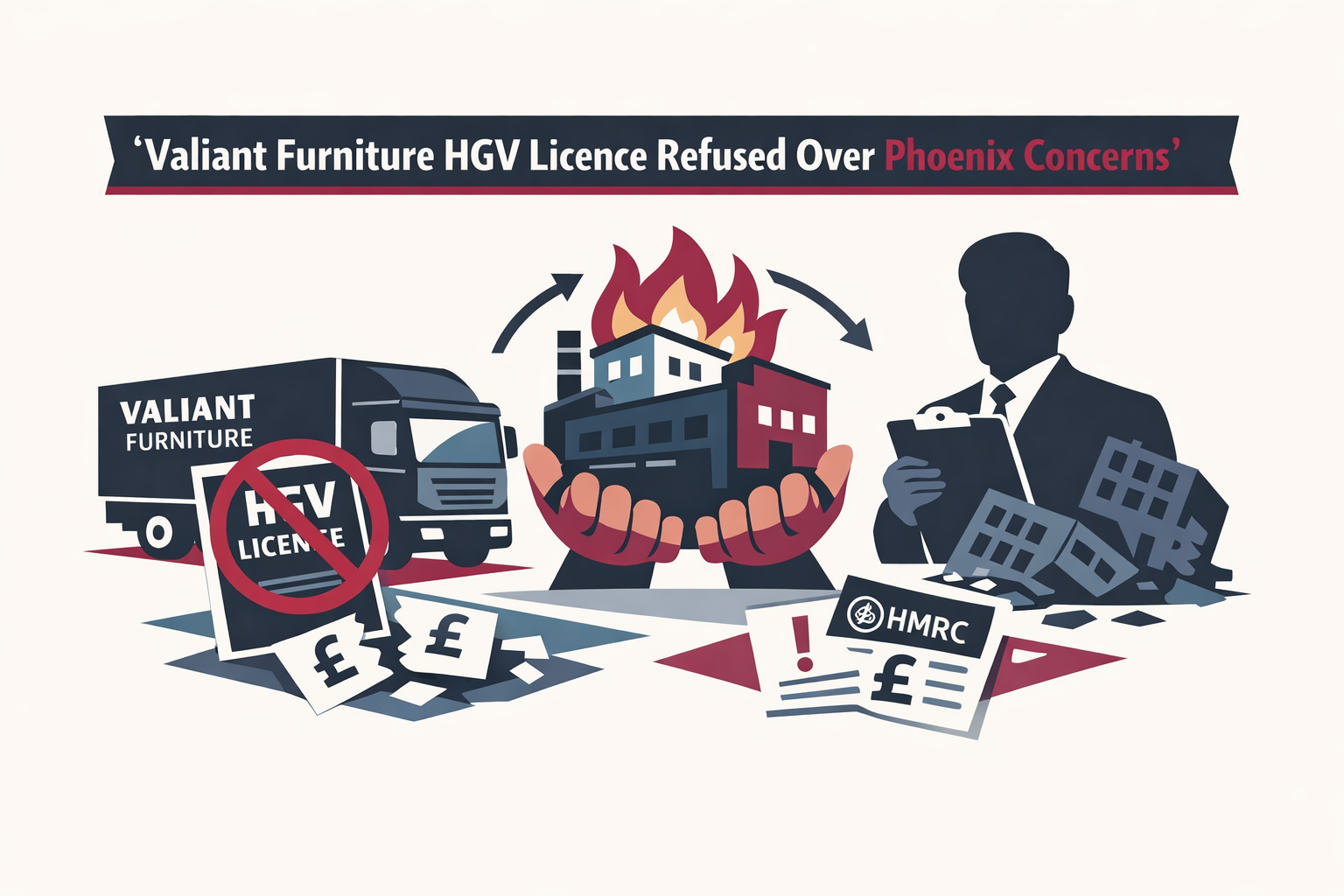
Deputy Traffic Commissioner Mark Hinchliffe has refused Valiant Furniture (NW) Ltd’s application for a restricted HGV operator’s licence authorising two vehicles, following a public inquiry in Haydock on 14 July 2026. The written decision is dated 16 July, published on GOV.UK on 22 July, and was followed by a Traffic Commissioners press release on 5 August. (gov.uk) This was not a case about missing paperwork or marginal finances. The Traffic Commissioners for Great Britain decision turned on whether the regulator should approve another company controlled by S J Urmston after a run of predecessor businesses had collapsed with large unpaid debts and trading had resumed through closely related successor companies. (gov.uk)
For creditors, the arithmetic is the real story. The written decision records that S J Units Ltd entered liquidation with a deficiency of about £440,000; S J Units (Lancashire) Ltd with more than £980,000; and Valiant Furniture Ltd, formerly S J Units Northwest Ltd, with an expected deficiency of about £475,000. On those published figures, the shortfall across the three failures comes to roughly **£1.895 million**. (gov.uk) The same decision says HMRC was left exposed in each cycle, alongside suppliers, banks and, in one case, employees. S J Units (Lancashire) Ltd alone is recorded as owing HMRC well over £200,000, trade creditors and banks around £620,000, and employees £14,000, with personal liability notices against Mr and Mrs Urmston of around £125,000 for unpaid national insurance contributions. (gov.uk)
What mattered to the Commissioner was fitness, not simply whether the latest company could show enough money for two vehicles. Under the Goods Vehicles (Licensing of Operators) Act 1995, the decision says the inquiry could examine Mr Urmston’s past trading, financial and administrative conduct as director of earlier licence-holding companies when deciding whether the new applicant was fit to hold a licence. (gov.uk) A restricted goods vehicle operator’s licence would have allowed the company to run vehicles for its own deliveries, and the decision notes that each predecessor business depended on operator licensing as part of the same trading model. Mr Hinchliffe treated the companies and the conduct of their controlling director as inseparable for this purpose. (gov.uk)
Mr Urmston, who attended the inquiry without representation, said the earlier failures were driven by events outside his control: withdrawal of NatWest facilities and a Romanian customer default in the first case, the Covid period in the second, and supplier problems in the third. He also said some former suppliers had effectively recovered part of old losses by charging successor companies more for materials. (gov.uk) The written decision shows the Commissioner was unconvinced. It describes those explanations as vague and uncorroborated, says they did not come close to explaining the repeated non-payment of PAYE, national insurance, VAT and other creditor claims, and warns that paying inflated prices to old suppliers looked liable to produce yet another collapse. That is a serious finding: not just that businesses failed, but that the explanations offered did not answer the creditor harm left behind. (gov.uk)
The most telling part of the judgment concerns the familiar signs of a phoenix operation without going as far as a formal insolvency law ruling. The decision says Valiant Furniture (NW) Ltd was incorporated in January 2026, applied for its licence in February 2026, and followed Valiant Furniture Ltd into the market just as that earlier company went into creditors’ voluntary liquidation. The Commissioner said the business appeared to move to pre-incorporated successor companies while the debts stayed behind. (gov.uk) Mr Hinchliffe also raised the use of strikingly similar corporate names and recorded that the applicant’s website still used the trading name Valiant Furniture while displaying the registered company number of the failed Valiant Furniture Ltd, not Valiant Furniture (NW) Ltd. A former liquidator later told the Traffic Commissioner’s office that notice of intended name reuse had been placed in The London Gazette and creditors had been notified, so the Commissioner did not make a finding of breach under section 216 of the Insolvency Act 1986. Even so, he treated the wider pattern as highly relevant to fitness. (gov.uk)
It is worth noting what did not save the application. The decision accepts that Mr Urmston is not disqualified as a director, has no known relevant convictions, had no recorded regulatory action against earlier operator’s licences, and that the applicant appeared to have enough money for a two-vehicle restricted licence. The Commissioner also accepted an explanation for some ANPR evidence and did not find unlawful operation of the one vehicle in the company’s possession. (gov.uk) Even with those points in his favour, Mr Hinchliffe concluded that the applicant was not fit to hold the licence. He described the sequence of insolvency, re-incorporation and resumed trading under slightly altered names as classic ‘Phoenix Syndrome’ and said granting another operator’s licence would damage confidence in both the transport sector and the regulator’s gatekeeping role. (gov.uk)
For insolvency watchers, the refusal matters because it shows one regulator refusing to treat repeated failure as background noise. The Traffic Commissioner was careful to say that corporate and insolvency law enforcement belonged elsewhere, and this decision is not a disqualification order or a court judgment on section 216. But it is still a public finding that the pattern of successor companies, repeated liquidation and unpaid debts made this latest applicant unfit for regulatory approval. (gov.uk) That leaves the question creditors will recognise at once. If a licensing authority can trace a near £1.9 million trail of deficiencies across connected companies and refuse its approval on that basis, what follow-up, if any, comes from the insolvency system itself? The GOV.UK decision answers the transport point. It does not answer who recovers the losses left with HMRC, suppliers, banks and staff. (gov.uk)